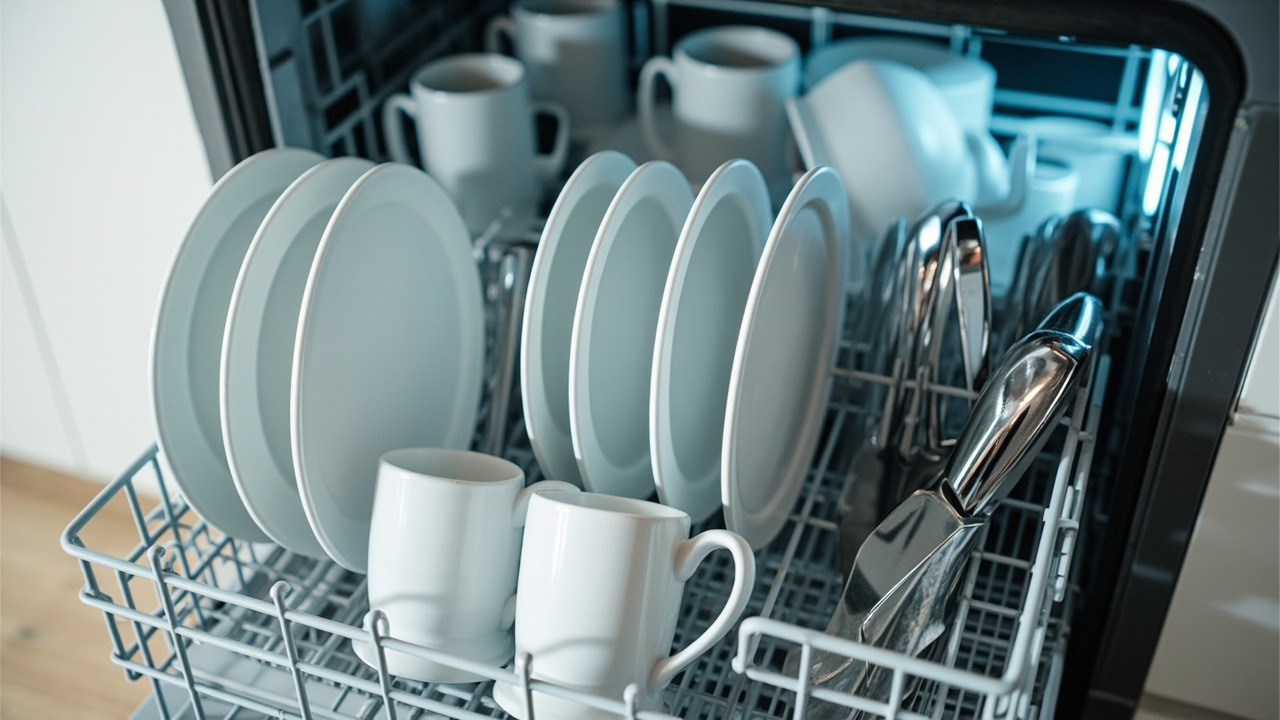
composo-ai/DishwasherBench is a dishwasher-loading game on a physical simulation of one real machine, built to benchmark language models and playable in a browser. The game inside is called Spotless and the packages are @spotless/*. What you do is load a Bosch SMV4HAX40G with a pile of plates, bowls, mugs, cutlery and pans, then watch the wash run on the Eco 50 programme — jets traced on the GPU from the nozzle positions measured on the machine, soil removed with a per-soil chemistry model over the whole programme, and an inspector that looks at every item afterwards and says whether it came out clean (at most 4 specks and 4 mm² of visible soil, counting what dirty water left where it stood).
The whole stack is in TypeScript, runs on Node 20.19 with pnpm 9, draws on WebGPU from Node via the webgpu package (version 0.6.2 carries prebuilt Dawn binaries; on a Mac that is Metal), and exposes one game server on port 8787 plus an MCP server on 8788 that speaks streamable HTTP. People play in the browser; models play through the same MCP server, with the same actions on the same grid, and every action is logged with a hash of the scene after it so the episode is replayable and verifiable. There is no other benchmark I know of where an LLM is being asked to plan a 3D rigid-body packing problem and is then scored by a GPU water-tracing sim that was calibrated on actual test washes of a physical machine.
The bet, in one sentence
The interesting claim is that plan-and-place agent benchmarks have been stuck on text grids, and a calibrated physical simulation is a more honest scoring surface for that class of task than another text-only agentic eval suite. Two GPT-6.1 deployments on an Azure endpoint, run at medium reasoning effort on 11 October, played three levels of the course through the MCP server at the official wash tier: six episodes, each one a single load and a single wash, and each one a record that anyone can verify by replaying its action log and by washing its load a second time. Both models beat the careful scripted reference load on both full levels (37-piece breakfast and 62-piece dinner party) by placing pans, a platter and boards that the scripted careful player never tries. Neither model made the mistake the levels are built around: no hollow piece was stood mouth up or laid on its side in six episodes, and what they loaded came out 84 to 100 % clean. The scores differ by what they fitted in.
The machine, in one paragraph
The model is a Bosch SMV4HAX40G, from photographs and tape measurements of the owner’s own machine (packages/machine). Both baskets are modelled with their tine rows, shelves, side rests and the fold-down knife shelf; the spray arms are modelled with their measured nozzle positions and turning; the Eco 50 programme is the scored programme, with one capsule of Finish Powerball Ultimate, 12.9 g, as the detergent. The sim is calibrated on the owner’s test washes — currently two of them, both egg-yolk plates on Eco 50, air-dried and oven-dried, some turned to the wall or stacked — and a parameter set called anchored-v8.owner-capsule records the state of the simulation source and the machine data it was made for, so that a change to either halts the wash and lists what differs. The result is a deterministic simulation that, run twice on the same load, gives the same points with every verdict the same, on one machine. Across machines, operating-system builds and versions of webgpu, results can differ in the last bits (docs/research/spike-gpu-compute-macos27-recheck.md); the README names this as the cross-machine variance.
The mechanism, in one stack
The loading physics is Jolt — every item and every part of the machine is a rigid compound of exact shapes generated from a parametric description; the picture, the collision shape, and the surfaces the wash sees all come from that one description. Items are placed with rigid-body physics at a fixed step, with the player’s inputs rounded to 1 mm and 1 degree, so a person and a model act on the same grid and the same load always settles the same way. Every action is logged with a hash of the scene after it; replaying the log must reproduce every hash.
The wash is a two-tier simulation. Jets are traced on the GPU from the measured nozzle positions and the arm rotation, onto the exact shapes of the load. Splash and drips travel as droplets; water that lands runs down surfaces as a film, pools where a surface holds it, drains where it does not. Soil is a per-soil model: time, temperature, the chemistry of the wash water (detergent, enzymes, bleach), over the whole programme. Where the water goes is cached apart from the soil and the chemistry, so a wash with other soil parameters replays in seconds to about a minute. The official tier works on blocks of 2 mm and is the scored result — an official wash of the largest level takes about five minutes on a MacBook Pro (Apple M3 Pro). The fast tier works on 4 mm and gives a preview in about a minute. An episode is a load and a wash; the inspector looks at every item after the wash and grades it 0 to 5 plus the binary clean/not-clean verdict.
The scoring is per item, per level card: an item is clean when it carries at most 4 specks and 4 mm² of visible soil, counting what dirty water left where it stood. Each item is worth a number of points stated on the level card; a clean item earns them, an item that is not clean or was left on the counter earns nothing. The seven hand-written levels of the course are numbered in order of difficulty: tutorial (12 pieces, 64 points), lunch-for-four (39, 232), weeknight-dinner (46, 269), breakfast (37, 220), mixed-family (45, 266), baking-day (46, 272), dinner-party (62, 367). A level passes when careful beats careless by at least a fifth of the points, careless beats random or holds 1.2× its points, a careful load cleans at least two thirds of what it loads, no more than a tenth of the level’s points rest on edge-of-clean verdicts, and a level that is not meant to fit whole leaves at least 15 % of its points on the counter in the careful load. Six of the seven levels pass every gate as of 17 October; the tutorial does not pass (its three cups all lean on the rest under the folded-down knife shelf, where the scripted careless hand cannot turn them, so its careless load has no cup the wrong way up and loses only 6 points — below the 20 % gate).
The MCP surface, in 13 tools
The MCP server is bound to one episode: you start the game server in benchmark mode, create the episode, and then start the MCP server against that session over streamable HTTP. The agent gets 13 tools — place, remove, reset, set_rack, start_cycle, get_level, get_item, get_state, render, preview, list_slots, check_load, get_report — and a --max-input-tokens budget per episode (the tutorial takes 0.4 to 0.65 million input tokens, a level of 37 pieces 2.5 to 2.8 million, the largest level 3.0 to 3.2 million, with 95 % or more of it read from the provider’s cache). The harness records tokens, the action log, the pictures the tools returned, and a cost when prices are given in .env. Each run writes record.json, a results table (results.md, results.json), the data of the game server it started (server-data/), and verifies the episode by replaying its action log.
The fact that the MCP server is bound to one episode is a design choice, not a restriction. It means an agent run is reproducible end-to-end: same episode id, same load, same wash, same score, every time. It also means the agent can’t talk to a different machine or a different load in the same session — the score is a function of the episode, and the episode is a function of the agent’s actions. That is the only honest scoring surface for a planning task on a physical simulation.
What the numbers actually show
Six model episodes, three levels, one Azure endpoint, medium reasoning effort. Two deployments: gpt-6.1-sol and gpt-6-astra.
| Level | Pieces | Random | Careless | Careful | gpt-6.1-sol | gpt-6-astra |
|---|---|---|---|---|---|---|
| 1 tutorial | 12 | 40 (62.5 %) | 58 (90.6 %) | 64 (100 %) | 64 (100 %) | not run |
| 4 breakfast | 37 | 36 (16.4 %) | 112 (50.9 %) | 174 (79.1 %) | 190 (86.4 %); second episode 188 (85.5 %) | 175 (79.5 %) |
| 7 dinner-party | 62 | 85 (23.2 %) | 100 (27.2 %) | 250 (68.1 %) | 260 (70.8 %) | 274 (74.7 %) |
Both models beat the careful reference load on both full levels. gpt-6.1-sol scored 190/220 on breakfast and 260/367 on dinner-party; gpt-6-astra scored 175 and 274. The first gpt-6.1-sol breakfast episode was replayed and re-washed with the same verdicts and points; the gpt-6-astra breakfast record no longer passes the load check of its replay (issue #67, the four first-run records that no longer verify, including the gpt-6-astra breakfast one). What both models did that the scripted careful player does not: they placed pans, a platter, and boards, which the careful policy never tries. What neither model did: stand a hollow piece mouth up or lay it on its side, in any of the six episodes.
The cross-load pattern: what decides the score is the hollow pieces. Of the 474 points between the careful and the careless scripted loads on levels 2 to 7, 363 — about three quarters — are charged to cups, glasses, mugs and little pots mouth up or on their side (56 at the lunch, 60 at the weeknight dinner, 56 at the breakfast, 61 in the family load, 60 on baking day, 70 at the dinner party). The rest is pieces the scripted hand took out for a nest that did not hold and could not put back, a glass no mistake was made with, and the plates and the cutlery. The models did not make that mistake class, and their scores differ by what they fitted in. Cross-cutting that: the careless load of the dinner party blocks the tablet’s path by accident — a glass laid on its side lies in it, and the load is washed without detergent. Of the 150 points between the careful and careless dinner-party loads, 76 are charged to mistakes made with the piece (70 to cups, 6 to a turned egg plate; 20.7 % of the level on their own, which is no margin) and 77 to pieces no mistake was made with. The careless policy leaves the tablet’s path as it falls; this is the one careless load of the seven in which it fell shut.
The careful share does not fall along the course — 100, 81, 74, 79, 82, 70, 68 % — and the difficulty of the levels (2.3, 3.7, 5.5, 6.3, 6.9, 7.1, 7.2 on the four-part scale of levelDifficulty) is a property of what is on the counter, not what the careful hand loses. The scripted careful player is not a player. The course is designed to be harder to load, not harder to wash, and the wash is what is being scored.
Trade-offs and what it doesn’t fix
The benchmark is one machine with one detergent. Programmes other than Eco 50, drying, spots and film on glass, items moved by the jets, soil settling on clean items, flaking of thick layers, and where a tablet lands outside its tray are all out of scope. The wash is calibrated on two test washes of one machine and on the published class means of a sister machine (the Bosch SMV6ECX51E); the parameter set is anchored-v8.owner-capsule, versioned, with a fingerprint of the simulation source and the machine data it was made for. Other machines would need their own calibration runs. The cross-machine variance is in the last bits; the README explicitly disclaims that nothing in the game, the benchmark results or the documents is a statement about the performance, quality or safety of any real product, and that the loading advice shown in the game is the project’s own summary of the manufacturer’s manual, not the manufacturer’s instructions. Composo is independent of BSH Hausgeräte, Bosch and Reckitt (Finish), and the trademarks are used only to identify what was measured.
The Anthropic adapter is tested against a local stand-in only (issue #13). The two models that have played were both deployed on the same Azure endpoint; the Anthropic path is in the harness but the only results are on OpenAI-compatible endpoints. The needs-Anthropic issue is size: small, no machine needed, and is the natural next thing for the maintainers to land before any Anthropic-published numbers are real. The MCP server is also a single-episode binding, which means an agent run that needs to compare two loads in the same session has to spawn two episodes — there is no “restart” tool that re-uses the same episode id.
Many of the parameters are estimates, not measurements. The bore of the lower arm’s holes and the speed of both arms are not measured (issue #43, size: small, needs-machine); the four open tape measurements of the machine (issue #11) are still to take; the test washes of the calibration protocol beyond the two owner washes (issue #9) are still to run; the tub’s right wall sometimes stops the basket (issue #12). Of the 46 loading phenomena in the suite, 9 are out of scope, and 17 of the other 37 pass; most of the sizes they expect are estimates, not measurements. The level of fidelity is high but the surface is still acknowledged to be under-measured, and the calibration tool’s predict command warns when there is no calibration.json beside the set.
The fast tier gets the same forks and knife wrong in every wash of the standard load (issue #46, size: medium); the tutorial fails its own gate (issue #16, size: small, needs a decision); the scripted players are neither a ceiling nor a floor (issue #17); four of the first-run episode records no longer verify (issue #67, size: small); the course gets fuller, not harder to wash (issue #18, size: large). Each of these is a known issue with a known size; none is blocking; all of them are tracked in the roadmap with the area label (simulation, calibration, benchmark, interface, platforms, housekeeping) and the size label.
The platform constraint that matters most: macOS only, tested on a MacBook Pro (Apple M3 Pro, 18 GB) under macOS 27, where every figure in this repository was measured. Linux and Windows are untested (issue #28, size: medium). The WebGPU backend through the webgpu package (version 0.6.2) loads on macOS 27 and does not load on macOS 14.7. So the headline numbers — 56.96-second official wash times, 84 to 100 % clean rates, 0.4 to 3.2 million input-token costs per level — are all macOS-on-Metal numbers. A Windows-on-DX12 or Linux-on-Vulkan run of the same benchmark is open work, and the cross-platform variance is part of what docs/research/spike-gpu-compute-macos27-recheck.md exists to track.
A different way to score an agent
The thing this benchmark is doing that the standard agentic-eval suite does not, is separating the planning cost from the wash cost. The agent does the planning — which items to place, where, in what orientation, and the order to do it in so the basket actually settles the way the placement said. The wash is then a separate calibrated function of the load, not a separate model judgement. An agent that places everything mouth up is penalised by the wash, not by a second model looking at the placement and saying “that looks bad.” An agent that fits every piece in is rewarded by the wash, not by a length-normalised “completeness” score. The agent’s job is to plan; the sim’s job is to grade. The boundary is real and physical, and the only honest scoring surface for a planning task on a physical simulation is one that uses the simulation.
What I would like to see from a future post in this lane is the cost curve plotted against the difficulty score — a Pareto front of (planning tokens, placement actions, final score) for each level, with the difficulty of the level as the x-axis. The careful scripted player is currently 100/81/74/79/82/70/68 % of the points on offer; the two GPT-6.1 deployments are 86.4 and 79.5 % on the breakfast and 70.8 and 74.7 % on the dinner party. The interesting question is not “do the models beat the scripted careful hand” — they do, on both full levels — but how much of the difficulty score they can recover per million input tokens, and whether that curve bends. The data is in docs/benchmark/first-runs/course/; the plots aren’t there yet.
References and where to dig further
- composo-ai/DishwasherBench — repo, MIT, Composo Limited.
- docs/README.md — index of the documents, with a reading order and a label for each (current, record of the build, or superseded).
- docs/benchmark/README.md — the harness, what each kind of player sees, what is recorded, the rules of an episode.
- docs/benchmark/levels.md — the seven levels, the difficulty measure, the gates, the reference washes, the soil lab.
- docs/design/scope.md — what was built first, what is out of scope, the status.
- docs/design/platform.md — the loading physics, the rigid-body step, the action log, the hash chain.
- docs/design/sim-core.md — the wash physics, jets, droplets, film, soil, the chemistry step.
- docs/calibration/anchoring-v8.md — the parameter set, what the wash is calibrated on, what it is not.
- docs/research/soils.md — the per-soil chemistry, the tenacity scale, the soaking behaviour, the bleach rate.
- docs/research/standards.md — the 46 loading phenomena, 76 washes, the executable pairs.
- docs/ROADMAP.md — the open problems, each with its area and size label.
- docs/benchmark/first-runs/course/ — the records, transcripts and pictures of the six model episodes.
- Jolt Physics — the rigid-body engine used for loading.
- WebGPU — the GPU API used for the wash tracing.
- Bosch SMV4HAX40G product page — the machine being modelled.
Comments
Powered by GitHub Discussions via Giscus. Sign in with GitHub to leave a comment.