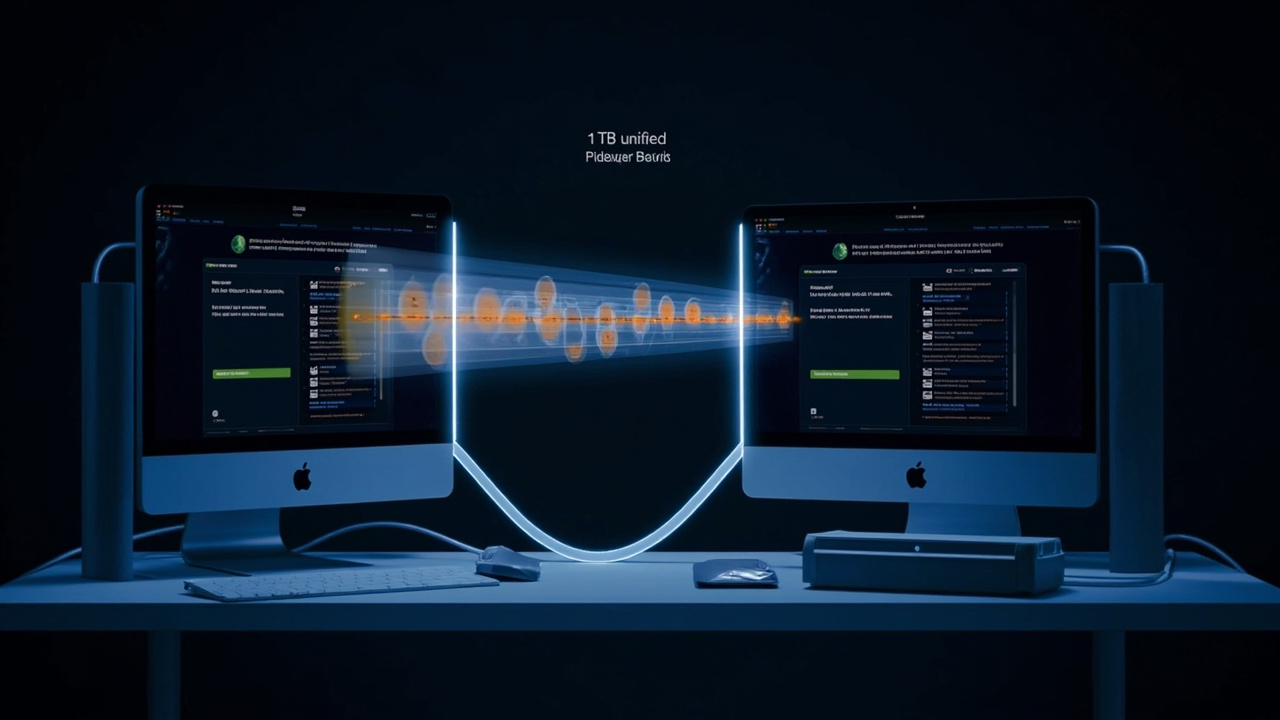
Meta released Muse Spark Open on October 15, 2026 — an 816B-parameter, 42B-active mixture-of-experts model with a 1M-token context window, the open-weights counterpart to its closed Muse Spark 1.3, and the first frontier-scale open release where the most interesting engineering isn’t in the model card. It’s in Apple’s MLX update that lets the model span two M5 Ultra Mac Studios linked by Thunderbolt 5 RDMA, pooling 1 TB of unified memory, and Apple’s own benchmark table that puts the result at 36.73 tok/s on four machines. The model itself is a tool-use leader and a coding laggard — that’s the part every other post will lead with. The desktop story is what the post is actually about.
The Mac Studio angle is the bit nobody in the inference-engine community had on their 2026 roadmap. Until now, the rules of thumb for where an 800B-class MoE can run were stable: at least 700 GB of VRAM for the NVFP4 build, around 2 TB for BF16, four Blackwell Ultra GPUs or eight H200s, 1.6 TB of fast disk for the checkpoint, and a small data center’s worth of cooling. Meta’s launch post quotes those numbers from the model card verbatim. The vLLM team at the same time published a day-0 blog with a working vllm serve recipe for NVFP4 on eight H200s. That’s the boring part — another big model, another set of GPUs. The interesting part starts with Apple’s MLX distributed inference page, published the same day, which lays out how to make the same checkpoint work on a desk.
The way the Mac build works is that the NVFP4 weights need around 493 GB to load, which won’t fit on a single M5 Ultra Mac Studio even with the 512 GB unified-memory configuration. So Apple’s MLX update splits the model across two machines and uses Thunderbolt 5’s new RDMA support — added in a December 2025 Thunderbolt spec update — to let the two Macs read each other’s memory without going through the host CPU. The unified memory architecture matters here because once a tensor is in memory, both the GPU and the Neural Accelerators on the M5 can read it without a copy. Two Mac Studios behave like one supercomputer with 1 TB of unified memory, as Meta’s launch post phrases it. Apple’s benchmarks measure text generation at an 8,192-token context, generating 128 tokens per test:
| M5 Ultra Mac Studio setup | Generation speed |
|---|---|
| Two Macs, pipeline parallelism | 15.74 tok/s |
| Two Macs, tensor parallelism | 24.99 tok/s |
| Four Macs, tensor parallelism | 36.73 tok/s |
The split between pipeline and tensor parallelism is a real engineering decision, not a benchmark decoration. Pipeline parallelism divides the model into sections that live on different Macs, so a token flows Mac A → Mac B → Mac A as it moves through the layers. Tensor parallelism shares the work inside each layer across machines, so every layer needs every Mac, but each Mac only holds a slice of every weight. Apple’s numbers say tensor parallelism wins — almost 25 tok/s on two machines vs 15.74 tok/s for the pipeline arrangement — but it requires that the inter-Mac bandwidth be high enough to keep every layer fed. That requirement is exactly what Thunderbolt 5 RDMA is for.
The reason this is the post and not just a press release is that the Thunderbolt 5 RDMA story has been quietly building for over a year. The Mac community has been waiting for it since the December 2025 spec, and Apple’s December 2025 update is the line that made distributed Mac inference possible at all. Before that, you could cluster Macs with Thunderbolt, but every cross-machine memory read went through the kernel, and the kernel couldn’t keep up with the rate at which transformer layers need their weights. RDMA bypasses the kernel. It’s the same primitive that lets Infiniband hold together GPU clusters in data centers. Apple just shipped it on a port that’s already on the back of a Mac Studio.
The Muse Spark Open launch also has a less-told story about MLX itself. MLX is the open-source array framework Apple published in 2023, and for most of its life it has been the answer to “I want to run a small model on my MacBook.” That’s a real use case but it’s not the same league as “run an 816B MoE on four Mac Studios.” The Muse Spark Open launch is the first time MLX is showing up in the same sentence as a frontier-scale model, and the only reason it works is the combination of three things: the M5 Ultra’s 1.2 TB/s of memory bandwidth, the 512 GB unified-memory tier that Apple just announced, and RDMA on Thunderbolt 5. Apple updated MLX specifically to support Muse Spark Open — added support for the M5 GPU’s Neural Accelerators, improved communication between connected Macs, and shipped a distributed-inference path that splits the model across machines. That’s an Apple engineering investment in a specific third-party model, and it landed the same day as Meta’s launch. Two companies with a famously adversarial history lined up for one announcement, and the reason is that the announcement was the first concrete answer to the question of where an 800B open-weight model can live that isn’t a data center.
The numbers are worth being specific about, because a lot of the early coverage was vague. The 816B/42B-active MoE is a 62-layer transformer where each layer swaps a dense feed-forward for a Mixture-of-Experts block of 256 experts with a router that picks 8 per token. The active parameter count is what determines per-token compute — 42B active on 8 experts per layer — and that’s why the model runs at roughly the speed of a 42B dense model even though it stores the weights of an 816B one. The 1M-token context window is enforced at inference; the vLLM recipe uses --max-model-len 1048576 to set it. Meta also released the model in BF16 and NVFP4; AMD separately released MXFP4 weights. The model card asks for at least 700 GB of VRAM for NVFP4 and 2 TB for BF16 on the GPU side; the Mac path needs around 1 TB of unified memory across two machines for the NVFP4 build. Unsloth’s smallest GGUF quants go down to about 2-bit and fit in roughly 300 GB of combined memory — that’s the “single high-memory workstation” tier that nobody’s calling a MacBook.
The model also has a more interesting benchmark story than the press releases let on. Meta’s model card compares it at xhigh reasoning effort against seven similar open models including Kimi K3, GLM 5.3, and Qwen3.8. The headline claim is “most capable US open-weight model to date,” but that’s specifically a US ranking — the Artificial Analysis Intelligence Index puts the model at 39, behind GLM 5.3, Kimi K3, and Qwen3.8 on the global open-weights board. Where it actually leads is in tool selection: MCP-Atlas 89.2 (vs 84.5 for Qwen3.8) and JobBench 61.8 (vs 61.4 for GLM 5.3). Where it trails is in terminal and repo work: Terminal-Bench 2.1 76.4 (Kimi K3 leads at 85.0), DeepSWE 1.1 60 (Kimi K3 at 68), SWE-Atlas-QnA 58 (Kimi K3 at 66). The honest read of the model card is that this is an agent-orchestration release, not a coding champion, and the “most capable” framing is narrow on purpose. One genuinely standout number is jailbreak resistance: 0.5 on StrongREJECT v2 with adaptive attacks, where no other model in Meta’s table scored below 62.9 — a direct payoff of the extra safety post-training the open-weights version got to handle running as standalone weights without system guardrails.
The license is the part that needs to be read carefully. The Muse Model License is not Apache, not MIT, not OSI-approved open source — it’s a custom Meta license. The two clauses that actually matter for production deployment are Section 2, which requires every product using the model or a derivative to prominently display “Built with Muse Spark Open” in the UI, docs, website, or settings menu, and Section 3, which says that any company offering API access to the model with group revenue above $20M in any 12-month period must notify Meta and sign a separate agreement before doing so. Section 3 has carve-outs: it doesn’t apply to internal use, research, or any commercial activity that isn’t Model-as-a-Service, and it doesn’t apply to using the model as a component inside the Licensee’s own product that isn’t itself a MaaS. The pattern is the same one Anthropic shipped with the Mythos launch and Z.ai shipped with GLM-5.3-Flash: open-source code, custom license on the weights, separate conversation required for serious commercial deployment. “Open weight” describes what you can download, not what you can resell.
The most useful deployment pattern for the Mac path is probably two-machine tensor parallelism, because it’s almost 60% faster than the pipeline alternative on the same hardware and the VRAM math is more forgiving. The four-machine tensor-parallel number at 36.73 tok/s is the upper bound of what you can get from a desk; the two-machine tensor-parallel at 24.99 tok/s is the lower bound that still feels like real-time agent work. For comparison, the Activepieces team ran an automation benchmark where Muse Spark Open through OpenRouter took 14.8 seconds per task at $0.0024 — that’s the cloud baseline, and a four-Mac-Studio setup would put a similar agent loop closer to the same wall-clock without the per-token cost. Whether that math pencils out depends on how many tasks per day you’re running and what your time discount rate is on data not leaving the building. At $5,499 starting price per M5 Ultra Mac Studio, the four-machine setup lands somewhere north of $22,000 before the 512 GB unified-memory tier ships later this month. That’s not a MacBook. But it’s also not a DGX H200 rental.
The model is on Hugging Face, Amazon SageMaker AI, Google Cloud Model Garden, and Microsoft Foundry Models. It runs day one on SGLang, vLLM, TensorRT-LLM, Hugging Face Transformers, Apple MLX, llama.cpp, and Unsloth, with optimizations for AMD, Apple, Intel, and NVIDIA silicon. The hosted endpoints — Baseten, Fireworks AI, Groq, Modal, Nebius, OpenRouter, Together AI — are the realistic way to test it before committing to hardware. vLLM’s day-0 blog is worth reading if you’re going to self-host on NVIDIA; the SGLang branch has custom Helion GPU kernels that Meta claims give 1.03–3.95× kernel-level speedups and a 3% end-to-end speedup on AMD MI350. The DSpark speculative decoder (Inferact/Muse-Spark-Open-DSpark) is the part of the recipe that actually moves the speedup needle on long-context prompts — num_speculative_tokens=7 with rejection_sample_method=block and enable_adaptive_verification=true is the configuration that landed in the vLLM blog.
What I’m still trying to figure out is how much of the desktop story survives a real agent workload. Apple’s 36.73 tok/s is measured on a 8,192-token context, not the 1M-token window the model advertises. The 1M context case is where the Mac path is most likely to fall off a cliff — every active token in the KV cache is on a different Mac than the weights it needs, and the cross-Mac bandwidth story changes character. The Meta team showed the model shipping real iOS changes to Ice Cubes (an open-source Mastodon client) and driving DaVinci Resolve end to end with the model reviewing footage frame by frame. Those are real workloads, but neither of them is documented with a benchmark number. I’d like to see a third party run the same Ice Cubes task on the four-Mac setup and report tokens-per-second over the full agent loop, not just the decode step. That’s the number that will tell you whether the desktop path is the future of agentic local inference or a tech demo that lives on a launch page.
Comments
Powered by GitHub Discussions via Giscus. Sign in with GitHub to leave a comment.