Atlas: Source Control for Coding Agents, Built on a Port of Zed’s ACP Stack
Pacifio’s Atlas describes itself in three words — source control for agents — and then spends the next 363 lines of its ARCHITECTURE.md earning them. The repo landed on star-history’s trending list this morning with 8,213 stars and 9 alpha releases in the last seven weeks (the most recent, alpha-0.3.4 Atlas Teams Early, two days ago on Sep 27). At first read it looks like another coding-agent UI: a Tauri v2 desktop app, a Rust backend, a React 19 frontend, sidebar of threads, tabs for chat and editor and terminal. The thing that isn’t like the others is the seam underneath. Atlas runs Claude Code, Codex, its own native engine, and any agent from the Agent Client Protocol registry as the same AgentConnection trait, behind a frozen SessionDelta wire enforced by a contract test. The README makes it sound like a tracker for what an agent did. The architecture doc makes clear it’s a port — the port — of Zed’s ACP stack, with the agent-id branching stripped out and capability gating put in its place.
Atlas built a source-control layer for agents, and the layering matters more than the headline.
The bet, in one sentence
Every commit should remember the agent session that produced it — the prompt, the tool calls, the reasoning — and the same agent runtime should run any of the four or five agents a team already has, without per-agent special-casing, so that switching agents mid-task doesn’t mean starting the explanation over.
The README states the three problems cleanly:
Agents start from zero every session. Switching agents loses the thread. Context lives in ten places.
The third is the one most teams feel first. Claude Code writes CLAUDE.md and its own memory files; Codex writes AGENTS.md and a different history file; Cursor keeps its own scratch. Nothing reads all of them at once. Atlas reads them, indexes them, and ships the result to whichever agent is currently answering the prompt. The first two are downstream of the third.
What’s actually hard on the agent side
Three numbers from the architecture doc frame the surface:
- 70 IPC domain modules.
src-tauri/src/commands/mod.rsdeclares 70pub modfiles, each owning one slice of the IPC surface — agents, git, terminal, memory, knowledge, telemetry, models, models_pricing, mcp, byok, and on. Adding a command is a three-edit rule (write the#[tauri::command], declare the module, register the handler); miss any of the three and the command either fails to compile or silently 404s from the frontend’sinvoke(). - 16 Rust crates in a single workspace, plus one deliberately excluded (
atlas-kb-server, built on demand at runtime under its own profile). The vendored engine sits undervendor/atlas-engineand resolves against the sameCargo.lockas the app. The repo went without a workspace for a long time “for a real reason” — the ported stack pinsagent-client-protocol2.0 with its schema crate pinned exactly, and no single Cargo resolution could hold that alongside the old stack’s=1.4.0pin. The workspace landed when the old stack was deleted (issue #38), so oneCargo.lockand onetarget/at the repo root, and[patch.crates.io]plus every[profile.*]live in the rootCargo.toml— cargo honors both only there. - 365 IPC verbs across the 70 domain modules, served by
commands/agents.rsalone (37 verbs covering spawn, new_session, send, cancel, kill, set_mode, set_model, set_effort, respond_permission, authenticate, threads_history, and the rest of the lifecycle).agent_host.rsholds the identity map between the frontend’s per-spawnAgentId/SessionKeyand the manager’s own keys, the history row kept current in the thread-metadata store, and cheapsnapshot_metaon the send path.
The cost of that surface isn’t a number — it’s the rule the doc spells out at the top of the backend section: every blocking operation must run inside tokio::task::spawn_blocking — Command::output/Command::spawn, file I/O over large trees, git subprocess calls, anything not already async. The Tauri command runtime is shared with the UI’s IPC channel; a blocking call there stalls every other in-flight command and freezes the UI. This is the rule you discover on day three when one rogue git status hangs every panel in the app.
The mechanism, in one trait
// crates/atlas-acp-thread/src/connection.rs (paraphrased from the architecture doc)
trait AgentConnection {
    fn prompt(&self, ...) -> ...;
    fn cancel(&self, ...);
    fn authenticate(&self, ...);

    // capability-gated predicates
    fn supports_load_session(&self) -> bool;
    fn supports_resume_session(&self) -> bool;
    fn supports_close_session(&self) -> bool;
    fn supports_logout(&self) -> bool;
    fn supports_http_mcp(&self) -> bool;

    // optional sub-traits, returned only when advertised
    fn model_selector(&self) -> Option<Arc<dyn ModelSelector>>;
    fn session_modes(&self) -> Option<Arc<dyn SessionModes>>;
    fn session_list(&self) -> Option<Arc<dyn SessionList>>;
    fn retry(&self) -> Option<Arc<dyn Retry>>;
    fn set_title(&self) -> Option<Arc<dyn SetTitle>>;
    fn telemetry(&self) -> Option<Arc<dyn Telemetry>>;
    // ...
}
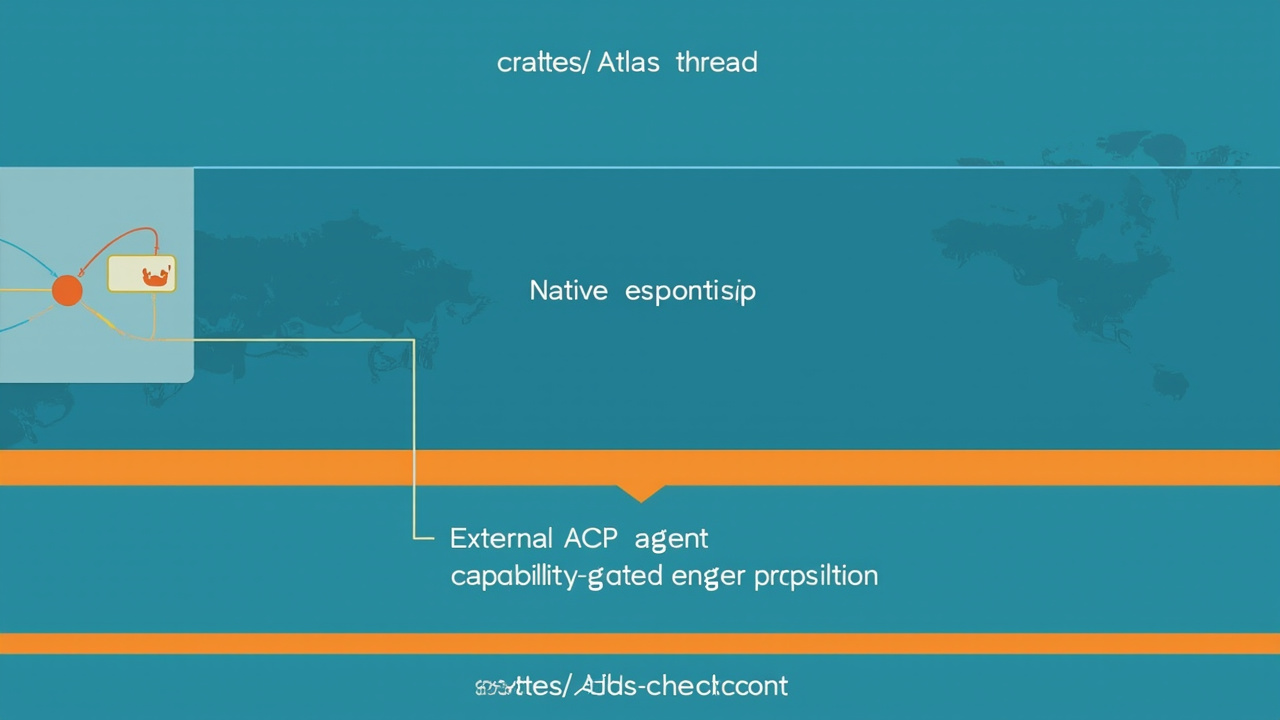
Two implementations live behind it: an external ACP agent reached through atlas-agent-servers (a subprocess over JSON-RPC over stdio) and atlas-native-agent, the vendored engine reached in-process. A caller asks the connection what it can do; it never asks who it is. Branching on agent identity is forbidden. The doc states this bluntly:
An
if agent_id == "claude"is a bug, not a shortcut — it is what made the pre-port stack impossible to extend to an agent nobody had hand-written support for.
This is the load-bearing invariant of the whole system. Everything below the seam — the manager, the host, the delta projector, the wire, the IPC surface — treats the connection as capability-shaped rather than identity-shaped. A new agent works if it implements AgentConnection and advertises its capabilities at initialize; it does not need an Atlas-side code path.
What’s actually new vs Zed
The architecture doc is candid that the agent stack is a port of Zed’s. The non-trivial work is in what was removed and what was added to make it portable.
Removed. The old acpSessionId-as-filename design collapsed “thread” and “session” into one concept. A thread is the conversation Atlas tracks, keyed by an id Atlas mints; it exists before any agent process and outlives one forgetting the session. A session is the agent-side conversation, keyed by an ACP session id. A thread references at most one session. The per-agent scrape readers that read other agents’ private storage to build history were deleted and must not come back — see docs/adr/0001-app-owned-thread-metadata-store.md. The Claude JSONL replay in atlas-agent-transcript is gone. The old SDK’s patch table (the two vendored-fork [patch.crates-io] overrides and their compile guards) was deleted with the previous native path itself.
Added. AgentManager (port of Zed’s AgentConnectionStore) folds the session ownership Zed spreads across its per-agent view into one place. A second connect request while the first is still connecting joins it rather than starting a second process. A failed connection does not stick — the entry records the error for waiters, then goes, so the next request retries instead of replaying the failure forever. A version bump drops the connection. DeltaProjector reconciles the thread model (one entry per assistant message with interleaved text and thought chunks) with the wire model (one message per contiguous run of a kind) — that gap is precisely atlas-agent-delta’s job, and the reconciliation is the whole reason the wire is frozen.
The frozen wire. Every delta travels an ordered OutboundPipeline (atlas-bus) of independent middleware: BroadcastMiddleware (the atlas:agents window event), CaptureMiddleware (Timeline + the permanent checkpoint record), AnalyticsMiddleware, TranscriptMiddleware, MemoryIngestMiddleware. The SessionDelta shapes those consumers pattern-match live in crates/atlas-agent-wire and are frozen. crates/atlas-agent-wire/tests/contract.rs spells the contract out itself and fails if the enum drifts. It also cross-checks docs/agents/delta-wire-contract.md when present — and that prose contract is git-ignored, which is exactly why the test does not rely on it.
What the numbers actually show
A checkpoint is the load-bearing concept for the user. The README: “A checkpoint links a commit back to the session that produced it: prompts, tool calls, and file changes kept together, queryable months later.” The data model is small but exacting:
- Sessions live in
<project-root>/.atlas/sessions.db(SQLite + blob sidecar), populated byatlas-checkpoint. Every session is redact-on-write: secrets are scrubbed byatlas-redact(Shannon entropy, vendored betterleaks rules, provider prefixes, credentialed URIs, connection strings) before anything touches disk.atlas-checkpointis Tauri-free, so the whole surface is testable against a real database and a real git repo. Push only — it drains the outbox to the ingest service and never reads a Session back. - The git linkage survives rebases and amends. When you commit from any tool — even with Atlas closed — the commit is linked back to the session that produced it, and the links survive rebases. The
atlas-gitcrate is one spawn chokepoint over the realgitbinary (so hooks run), a typed stderr→error taxonomy with friendly messages (ported from GitHub Desktop/dugite), porcelain-v2 status parsing, streaming output for long operations. - The Timeline cloud half is
atlas-artifacts. It owns the read half — remote Sessions, comments, one WebSocket per connected cloud Project — built onatlas-comms. The invariant that makes a merged board possible:rowIdon the wire is the local row id, so local and remote rows share one identity and a comment anchor resolves against a local row with no mapping table.
Local mode works fully offline, no account. You select a checkpoint and chat with it directly; it answers from what actually happened in that session. The on-device RAG engine is atlas-memory — MiniLM embeddings, usearch HNSW behind a MemorySearchFn seam, with the shared-memory record store (record: SQLite per repository scope, redact-on-write, one-time legacy migration). Global promotion of Facts seen in two or more repositories moves them to ~/.atlas/memory (global). Embedding runs on your machine; retrieval never leaves the device.
The headline numbers for context:
| Subsystem | Path | Crate | Scope |
|---|---|---|---|
| Session history (metadata only) | <app-config-dir>/threads.db | atlas-thread-metadata | Global (cross-project) |
| Session record / Timeline | <project-root>/.atlas/sessions.db + blob sidecar | atlas-checkpoint | Per-project (one worktree) |
| Shared memory record | <scope-root>/.atlas/memory/memory.sqlite | atlas-memory | Per-repository (one main worktree) |
<app-config-dir> is Tauri’s app_config_dir() — ~/Library/Application Support/dev.atlas.ide/ on macOS. History is global because threads are grouped across projects; the checkpoint record is per-project because a Timeline is about one worktree; shared memory is per repository — its scope root is the main worktree (found through the git common dir), so every worktree of a repository shares one record. This three-tier split is deliberate. Conflating it is the mistake that any of the other agent UIs that bolt onto an existing editor would make.
What’s hard on the agent-runtime side
Three of the gotchas in the architecture doc are worth quoting because they are the kind of thing you don’t find out until production:
The old SDK’s patch table is gone (#54). The two vendored-fork
[patch.crates-io]overrides and their compile guards were deleted with the previous native path itself. The two failure classes they fixed are still guarded, by tests against the engine that replaced them rather than by a patch table: a chunk-split fixture that splits an SSE frame at every byte position, and a cancel test that asserts on the filesystem — the killed command’s marker file never appears.
vite.config.ts’sdedupeis load-bearing. Lazy-loaded language packages each transitively import@codemirror/{state,view,language}and@lezer/*; withoutdedupe, Rollup can ship two copies in the production bundle.EditorView.theme(...)then registers against one copy’sStyleModulewhile theEditorViewconstruction uses the other, and the theme silently no-ops — text renders unstyled. Same story forpdfjs-dist. Dev mode does not reproduce either failure (Vite serves a single pre-bundled instance) — this only shows up in production builds.
Release-profile
panic = "unwind"is required. The local-LLM loader (atlas-embed, used by memory chat)catch_unwinds candle’s Metal kernel-compile panic to fall back to CPU.panic = "abort"would crash the app outright instead of degrading gracefully; the cost is a small amount of extra binary size for unwind tables.
The third is the kind of thing you only learn after watching a Metal compile panic on a customer’s machine and wondering why the whole app died instead of falling back. The first is the kind of thing you learn after a streaming-SSE chunk split in the middle of a Unicode code point and the agent ate the rest of the response.
And the PATH resolution gotcha is its own class:
PATH resolution. macOS strips
PATHfrom GUI-launched processes, so a bundled.appcannot see a user-installed agent CLI that a terminal in the same account finds fine.crates/atlas-agent-servers/src/host_env.rsresolves the real one: a fast guessed pass, then the user’s actual login-shellPATHvia$SHELL -lc 'echo $PATH'under a short timeout, because no static guess covers every version manager.
Every macOS desktop agent app ships this bug eventually. Atlas’s host_env.rs handles it by shelling out to $SHELL -lc 'echo $PATH' and giving up after a short timeout — the only reliable path when the user has nvm, pyenv, asdf, mise, or any of the other version managers that don’t put their shims in /usr/local/bin.
What Atlas Teams Early actually unlocks
The Sep 27 release was titled Atlas Teams Early. The feature surface that was already in place for it — from docs/adr/0014-organisation-tool-server.md — is the organisation tool server (org_server/, /org, atlas_org): it lets Atlas Agent read the organisation a Project belongs to — members, conversations, the inbox, recorded sessions and their comments — and act in it as the signed-in user.
The hard part isn’t the read side. It’s the write side. Outward actions — org_comment_reply and org_send, the tools that reach another person — ask first: the offer declares them in its ask-first list, the native seam projects each with a per-tool Prompt, the engine asks as an MCP elicitation that the seam serves only for a server Atlas offered the thread, and the approval card shows the recipient and the full body from the host’s describe_call — sharing its argument parsing with the post so the card is what is sent. Every remote operation goes through one trait, the organisation cloud (cloud.rs, OrganisationCloud); the production AppOrganisationCloud wraps the artifacts client, the chat (comms) client, and AuthCore, which already hold the bearer in Rust; the tests run the real listener against an in-memory FakeOrganisation. The check on every call is: setting on, someone signed in, session’s Project bound to a Workspace. Switching the window’s active organisation cannot redirect a turn — the grant is stamped on the session and re-checked.
The interesting part is what this means for the wire contract. A team-session delta is a different shape than a single-session delta; the wire had to grow a way to carry it without breaking the contract test that the whole stack relies on. The fact that the contract test is still passing with the new shapes is the evidence that the freeze held — that adding a feature didn’t require renegotiating the wire with five other crates. That’s the test the doc is most proud of, and rightly.
Trade-offs and what it doesn’t fix
Three honest limits.
First, the native agent is a fork, not an integration. vendor/atlas-engine is a hard fork of an Apache-2.0 upstream (see CONTEXT.md, ADR-0003 and ADR-0011). The fork’s agent id is the literal "atlas-agent" — a storage key every thread row resolves through, so renaming it is a data migration (ADR-0011). Anyone who depends on Atlas tracking a specific agent under a different id will have to migrate. The fork is the price of running an agent in-process alongside external ACP agents; the alternative is to make Atlas Agent just another external subprocess and lose the atlas-org access.
Second, the desktop-platform support is narrow. macOS 13+ (Apple Silicon or Intel) and Windows 10+ (x64) are the supported platforms. The Linux build compiles from the same Tauri codebase but is “untested — see Build from source.” The README has a #todo homebrew tap so this becomes \brew install atlas“. For a tool that wants to be “source control for agents” in a team with mixed OS, the missing Linux binary is a real limitation. (For Apple-silicon-and-Windows teams, it’s invisible.)
Third, the org-server’s outward actions are ask-first, which is the right default but a real friction cost. Every org_send triggers an MCP elicitation; every org_comment_reply shows the approval card. A team running Atlas Agent as a junior engineer who needs to send 30 status updates in a sprint will feel the prompts more than they feel the value. The doc’s framing is that this is the cost of acting as the signed-in user and the cost is worth paying. That judgment will be wrong for some teams.
The interesting limit that the doc does not flag but that the architecture makes obvious: the system only gets cleaner the more agents implement AgentConnection and advertise their capabilities honestly. A misbehaving external agent that returns wrong capability flags (advertising supports_http_mcp: true when its MCP server is down) gets routed to a dead path with no fallback. The capability model is trust-the-agent, which is the only sensible default for an open protocol — but it means Atlas inherits every external agent’s bugs.
Digression: the one migration that isn’t optional
If you read enough of the architecture doc you find that there is exactly one piece of legacy storage the team hasn’t deleted: the Claude JSONL replay path in atlas-agent-transcript. It used to hold the Claude session log so Atlas could replay it. The replay is gone, but the file format the importer reads is preserved, under its own contract, because some teams have years of Claude sessions they want to import into Atlas’s checkpoint record. The doc calls this out as a deliberate read of CLI directories — alongside the memory/skills surfaces that read instruction files (CLAUDE.md, AGENTS.md, skills) as documents — and notes that CONTEXT.md records one flagged exception, the Memory panel’s Codex thread list.
That’s the right way to phase a port: keep the importer, drop the live read. The line “the per-agent scrape readers were deleted and must not come back” is the rule that lets the rest of the doc trust the app-owned store.
Final paragraph
The most interesting thing about Atlas isn’t the checkpoint record — though the checkpoint record is the thing every team using it will actually feel. It’s that the agent runtime has been decoupled from agent identity at exactly the layer where the rest of the industry still ties them together. The frozen wire, the capability-gated AgentConnection, the app-owned thread store, the path-dependency workspace that pins agent-client-protocol 2.0 exactly — none of this is exciting on its own. Together they make a system where adding an agent is “implement AgentConnection and ship a binary” rather than “land a PR into Atlas.” Whether the rest of the agent ecosystem agrees to write to that seam — rather than to Atlas-specific code paths the way Claude Code does to most of the desktop apps that integrate it — is the question the next six months will answer.
References and where to dig further
ARCHITECTURE.md— the 363-line doc most of the above is drawn fromCONTEXT.md— thread/session/draft/archive vocabularydocs/adr/0001-app-owned-thread-metadata-store.md— the ADR that retired the per-agent scrape readersdocs/adr/0002-no-default-acp-agents.md— the rule that “a fresh install has no ACP agents at all”docs/adr/0011-atlas-agent-id-migration.md— the storage key that makes the agent id a data migrationdocs/adr/0014-organisation-tool-server.md— the org-server wiring that makes Atlas Teams Early possiblecrates/atlas-agent-wire/tests/contract.rs— the test that freezes the wire- Agent Client Protocol — the JSON-RPC-over-stdio protocol Atlas ports
Comments
Powered by GitHub Discussions via Giscus. Sign in with GitHub to leave a comment.