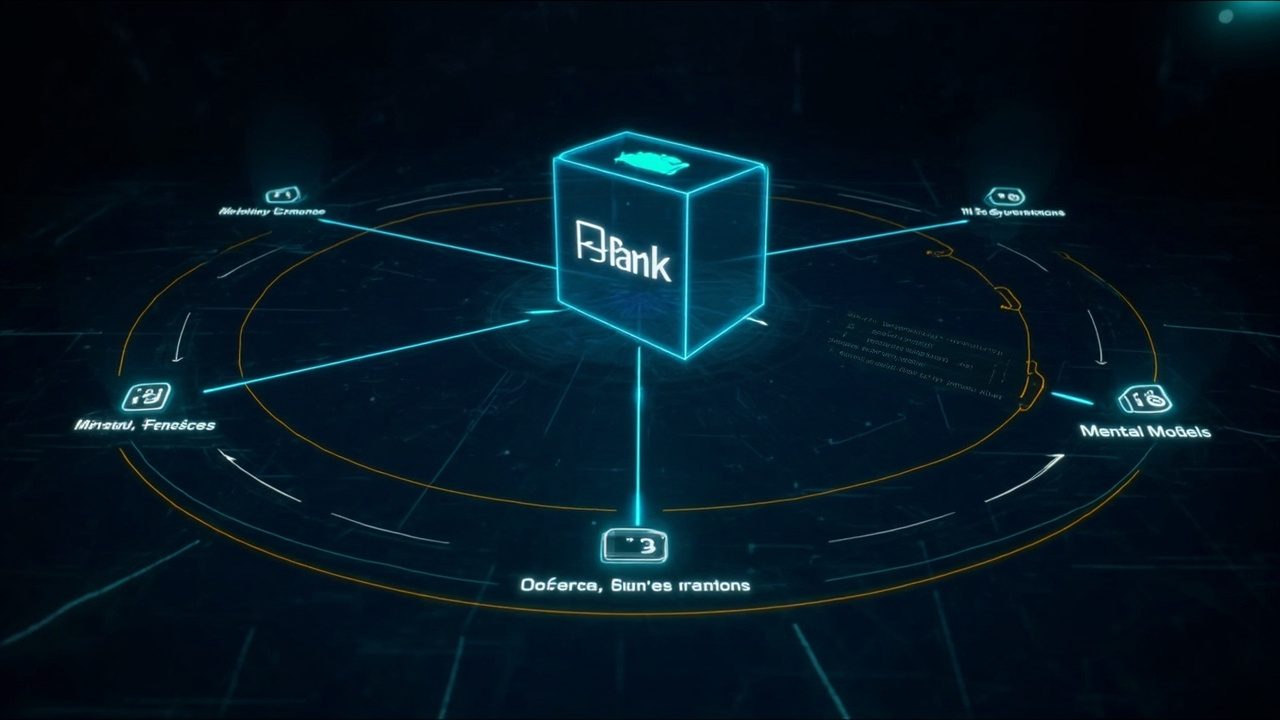
Most “agent memory” is a vector store you forgot about. You embed the conversation, you store the chunks, you push the top-k into the prompt, and the model answers as if it’s the first time it’s ever heard of you. Hindsight — Vectorize.io’s open-source agent memory layer at vectorize-io/hindsight, MIT, currently at v0.10.1 (released 2026-09-21) — is an attempt to make that loop look amateurish. The vendor chart on the README puts Hindsight at 94.6% on LongMemEval, against SuperMemory at 85.92%, Zep at 71.2%, and GPT-4o at 60.2%. The arXiv paper “Hindsight is 20/20: Building Agent Memory that Retains, Recalls, and Reflects” (Latimer, Boschi, Neeser, Bartholomew, Srivastava, Wang, Ramakrishnan, arXiv 2512.12818, Dec 2025) reports 39% → 83.6% accuracy lift with an open-source 20B backbone over a full-context baseline with the same backbone, and 91.4% on LongMemEval / 89.61% on LoCoMo at scale (vs 75.78% for the strongest prior open system). The numbers are real. The architecture is the post.
The bet, in one sentence
Memory that learns — rather than memory that recalls — needs a substrate that distinguishes evidence from inference, refuses to silently overwrite old beliefs when new facts arrive, and exposes a reasoning layer that can think over its own state instead of just retrieving from it.
The README frames this as the difference between “remembering” and “learning.” A vector store remembers by storing chunks and retrieving by similarity. It does not know that “Alice was a junior engineer in 2024” and “Alice got promoted to senior engineer in 2026” are about the same entity with a relationship change; it just stores both chunks and hopes a cross-encoder catches the temporal inversion. Hindsight’s design pushes that knowledge into the substrate. The memory model is four logical networks, not one pile of chunks.
What’s actually in the bank
The four memory types, named explicitly in the README and the paper:
- World facts — knowledge about the world (“the stove gets hot”). These are facts that don’t depend on the agent’s experience.
- Experiences — the agent’s own experiences (“I touched the stove and it really hurt”). First-person, episodic.
- Observations — consolidated, evidence-backed beliefs formed from many memories. Each observation keeps its supporting evidence with exact quotes and a proof count, and is refined rather than overwritten when new evidence arrives.
- Mental models — learned understanding of the agent’s world, synthesized from observations and facts. Standing answers to standing questions.
The interesting structural choice is #3 — observations are not the same as memories. A fact (“Alice works at Google”) goes in as an experience. When a bunch of related facts accumulate, an observation is consolidated: deduplicated, evidence-counted, and tied back to the exact quotes that produced it. New evidence doesn’t overwrite the observation — it strengthens, weakens, or extends it. The proof count is visible.
This is the part that distinguishes Hindsight from the prior memory architecture paper trail. A Zep, a Mem0, a Letta — all of them eventually overwrite. A flat vector store has no concept of “evidence” at all. The mental model layer sits on top: define a question once (“What are this user’s preferences?”), Hindsight writes the answer, stores it, and rewrites it in the background as the bank learns more. Reading one is a database read — no retrieval, no LLM call. The agent boots with a page of settled knowledge instead of rediscovering it every session.
The trade-off the paper makes explicit (and that anyone deploying this should care about): “evidence” here is quote-level, not retrieval-set-level. The system can show why it believes what it claims. That’s not a debugging nicety — it’s a structural feature. If your reflect layer produces a wrong answer, the bank can show you which observation produced it and which proof-quotes back that observation. You can’t do that with a top-k vector store without keeping the prompt in a separate audit log.
The mechanism, in three operations
The API surface is three verbs:
client.retain(bank_id="my-bank", content="Alice got promoted to senior engineer",
              context="career update", timestamp="2025-06-15T10:00:00Z")
client.recall(bank_id="my-bank", query="What does Alice do?")
client.reflect(bank_id="my-bank", query="What should I know about Alice?")
Retain runs an LLM extraction pass over the content, pulls entities, relationships, time data, and normalized facts, then pushes them into the bank along world-facts and experiences pathways as entities + relationships + time series + sparse/dense vector representations. There is no “embed and shove in a table” — there’s a normalization step that takes the extracted data to canonical entities, time series, and search indexes along with metadata.
Recall runs four retrieval strategies in parallel and fuses them: semantic (vector similarity), keyword (BM25), graph (entity / temporal / causal links), and temporal (time-range filtering). The merged result is reranked by a cross-encoder and trimmed to fit the token budget. The reciprocal-rank-fusion + rerank pattern is a familiar IR technique; what matters is that Hindsight ships all four retrieval modes against the same bank, not one mode with bolted-on supplements.
Reflect is the operation that doesn’t exist in vector-store memory. It’s a deeper analysis over the bank’s observations, used for “what should I know about X” rather than “what does the document say about X.” The README gives three canonical use cases — an AI project manager reflecting on risks, a sales agent reflecting on what outreach worked, a support agent reflecting on what questions aren’t covered by the docs. This is where the architecture earns the “learns” claim — reflection can update observations with new evidence-backed reasoning in a traceable way, instead of just re-running recall.
The MCP-first design is in the same family of decisions. Every server ships a built-in Model Context Protocol endpoint at http://localhost:8888/mcp/{bank_id}/, one per bank, enabled by default. You point any MCP client at it and retain, recall, reflect become tools. No wrapper code. The same bank can be exposed to Claude Code, Codex, Cursor, or an in-house agent with identical semantics. The LiteLLM wrapper takes the integration the rest of the way down — wrap_openai(OpenAI(), bank_id="user-123") and the wrapped client automatically recalls before the call and retains after, with per-call overrides on bank, recall budget, fact types, and reflect-vs-recall. Two lines of code, 25+ LLM providers underneath.
What the numbers actually show
The headline claim: 94.6% on LongMemEval (vendor chart, January 2026). The other systems on the same chart:
| System | LongMemEval Overall |
|---|---|
| Hindsight | 94.6% |
| SuperMemory | 85.92% |
| Zep | 71.2% |
| GPT-4o (no memory) | 60.2% |
The paper’s numbers tell the same story from the other side:
- 20B open-source backbone + Hindsight: 83.6% on LongMemEval, against 39% for the same backbone with full-context (i.e., shoving the entire conversation history into the prompt). The architecture is doing 44.6 points of the lift; the model is the same.
- Hindsight at scale: 91.4% on LongMemEval, 89.61% on LoCoMo. The paper’s 75.78% prior-best-open-system on LoCoMo gives a 13.8-point gap.
- The reproduction caveat the README is unusually explicit about: “The benchmark performance data for Hindsight has been independently reproduced by research collaborators at the Virginia Tech Sanghani Center for Artificial Intelligence and Data Analytics and The Washington Post. Other scores are self-reported by software vendors.” SuperMemory and Zep numbers in that chart are vendor-self-reported. Hindsight’s are not.
The latency story isn’t in the chart but is on the live benchmark site (benchmarks.hindsight.vectorize.io) — the README defers to it for per-model accuracy, latency, and cost. Mental-model reads are database reads (no LLM call), which is the only reason this is deployable at all in latency-sensitive chat paths.
Production shape
The deployment matrix is the second-most-interesting thing after the architecture. Five install paths:
# Docker (recommended) — uses embedded pg0
docker run -it --pull always --name hindsight --restart unless-stopped \
  -p 8888:8888 -p 9999:9999 \
  -e HINDSIGHT_API_LLM_API_KEY=$OPENAI_API_KEY \
  -v hindsight-data:/home/hindsight/.pg0 \
  ghcr.io/vectorize-io/hindsight:latest

# Docker with external Postgres
cd docker/docker-compose && docker compose up

# Bare metal (pip)
pip install hindsight-api
export HINDSIGHT_API_LLM_API_KEY=sk-xxx...

# Kubernetes — Helm
helm install hindsight oci://ghcr.io/vectorize-io/charts/hindsight \
  --set api.llm.provider=openai --set api.llm.apiKey=sk-xxx \
  --set postgresql.enabled=true

# Embedded (no server) — same process as the agent
pip install hindsight-all
The embedded path is the one most agents will actually use. HindsightServer(...) runs in-process, HindsightClient(base_url=server.url) connects to it, the agent code is unchanged from the hosted path. The Intel-Mac fallback ships as hindsight-all-slim. The PostgreSQL storage layer supports pgvector; Oracle AI Database 23ai is supported with “full feature parity” per the storage docs.
The 60+ integrations page is the part that will quietly matter: every coding agent on the current market — Claude Code, Codex, Cursor, GitHub Copilot, opencode, Cline, Aider, Zed, Continue, Roo Code, OpenHands — gets memory via npx @vectorize-io/hindsight-coding-agents install all, which builds a per-repo bank from git history and past sessions, injects it into the agent at start, and ingests new sessions automatically. The README notes that “DeepSeek Harness” is also on the supported list, which is interesting given how many agent runtimes are showing up in this space.
The memory-defense feature is the third non-obvious call: an opt-in per-bank policy that scans every retain for secrets and PII against 45 patterns and either redacts the match ([REDACTED:github_token]) or blocks the item before it reaches storage. There’s a release note in v0.10.1 from @cdbartholomew — “fix(memory-defense): redact Hindsight Cloud API keys” — which tells you this is a feature the team is actively tuning in response to real reports. The opt-in design is right; an always-on redaction layer would corrupt the benchmarks Hindsight is trying to win.
Trade-offs and what it doesn’t fix
The architecture is heavyweight. Retain runs an LLM extraction pass. Recall runs four parallel retrievals plus a cross-encoder rerank. Reflect is a deeper reasoning call. A naive “wrap every LLM call with Hindsight” integration pays for retain + recall on every turn. The LiteLLM wrapper’s defaults are tuned for chat, but anything in a hot loop needs to know what it’s paying for. The README’s benchmarks site publishes latency numbers per model, but doesn’t surface a per-operation latency guarantee — you’ll want to measure it on your own workload before putting a memory layer in front of every tool call.
The score ceiling is bound to your backbone. The paper is explicit: “Scaling the backbone further pushes Hindsight to 91.4%.” The vendor chart’s 94.6% is presumably with a stronger backbone than the 20B model used in the paper’s headline result. You can ship Hindsight with gpt-5-mini or claude-haiku-4-5 and get the architecture benefits; you cannot ship Hindsight with a 7B local model and expect the published benchmark scores. The memory substrate improves organization but does not invent reasoning.
The biomimetic framing is a metaphor, not a guarantee. World facts / experiences / observations / mental models is a useful organizing principle. It is not a verified simulation of human memory consolidation. The paper’s abstract is careful: “biomimetic data structures to organize agent memories in a way that is more like how human memory works” — more like, not identical to. The proof-count-on-observation pattern is structurally similar to how the source citations in a Wikipedia article work, which is the right prior to compare against if you’re trying to reason about how a memory layer ages.
The 60+ integrations are the moat, not the architecture. Hindsight can lose a benchmark to a better-architected competitor and still win the deployer — because every Claude Code, Codex, Cursor, and Copilot user has a one-liner install path. That integration surface is what makes the “Fortune 500 production deployments” claim in the README worth taking seriously. The team that ships a competing architecture will spend a year building the install matrix.
The thing I’d want to test before betting on it: how does observation-evidence survive a contradictory fact? If “Alice works at Google” (proof count: 3) is followed by “Alice left Google” (proof count: 1), does the observation weaken, split into two, or stay at strength 3 until the next consolidation cycle? The paper claims “refined rather than overwritten,” but the exact mechanism on contradiction is what determines whether the system is robust or silently accumulates stale beliefs. Worth a follow-up post once I’ve watched one run end-to-end.
Where to dig further
- Hindsight GitHub — the source. CLAUDE.md at the root documents the local-dev stack:
./scripts/dev/start.shfor the API + control plane,hindsight-api-slim/uv run pytestfor tests,hindsight-cli/cargo build --releasefor the CLI binary,ty check(Astral’s type checker) for typechecking. The repo’s.env.exampleis 47KB, which tells you how many knobs the configuration hierarchy exposes. - arXiv 2512.12818 — “Hindsight is 20/20: Building Agent Memory that Retains, Recalls, and Reflects.” The architecture description and benchmark setup. Worth reading alongside the README for the parts the marketing copy skips.
- Benchmarks dashboard — live, continuously updated. The per-model accuracy / latency / cost numbers the README defers to.
- RAG vs Hindsight — the comparison page the team ships for the question every reader will ask in the first 30 seconds.
- Memory Defense docs — the 45-pattern secret/PII scanner. Opt-in, but worth reading before you ship a bank that touches production user data.
The “what should I know about Alice” example in the reflect section is the right one to end on. A vector store answers that with top-k chunks and hope. Hindsight answers it with a mental model that the bank has been writing in the background, refined by every new fact that touched Alice’s record, with proof quotes that survive in the observation layer for as long as the observation does. The architecture is the bet: that an agent’s memory is a substrate for reasoning, not a cache for retrieval. The 94.6% is the validation that the bet pays off — at least on the benchmark the team chose to publish.
Comments
Powered by GitHub Discussions via Giscus. Sign in with GitHub to leave a comment.