The EU AI Act became fully applicable on August 2, 2026, closing out a staggered rollout that started when the regulation entered force on August 1, 2024. The full applicability date is the moment most of the operational obligations become enforceable — not the moment the law was passed.
This post isn’t a compliance checklist. It’s an explanation of what the regulation is trying to do, why each risk category exists, and where the obligations land when you’re building AI products. If you’ve been treating the AI Act as something “regulators worry about,” this is the post that makes it a systems-design concern.
The reason the regulation exists
The EU AI Act came out of two converging concerns that the existing regulatory framework couldn’t address:
First: a coordination failure around high-risk AI systems. Pre-2024, AI deployed in hiring, credit scoring, education, biometric identification, and critical infrastructure was governed by a patchwork of sectoral regulation — equal treatment law, data protection law (GDPR), product safety law — none of which was designed for AI as a category. The result was predictable: each regulator interpreted their own mandate narrowly, and cross-cutting concerns (model transparency, post-deployment monitoring, fundamental rights impact) fell between the cracks. The AI Act’s risk-tier framework is the EU’s attempt to close that gap.
Second: general-purpose AI as a structural category. Foundation models, large language models, and multimodal systems don’t fit into sectoral buckets. A single model can be used for hiring (regulated), creative writing (not regulated), medical triage (heavily regulated), and code generation (lightly regulated). The pre-2024 framework assumed the AI system would be the unit of regulation; the post-2024 framework treats the foundation model as a separate unit, with obligations attached to the model itself rather than only to its downstream deployments. Articles 50–55 are the GPAI-specific provisions, enforceable from August 2, 2025.
These two concerns are why the AI Act exists. Everything else — the risk categories, the conformity assessments, the post-market monitoring — is the implementation detail.
The four risk categories
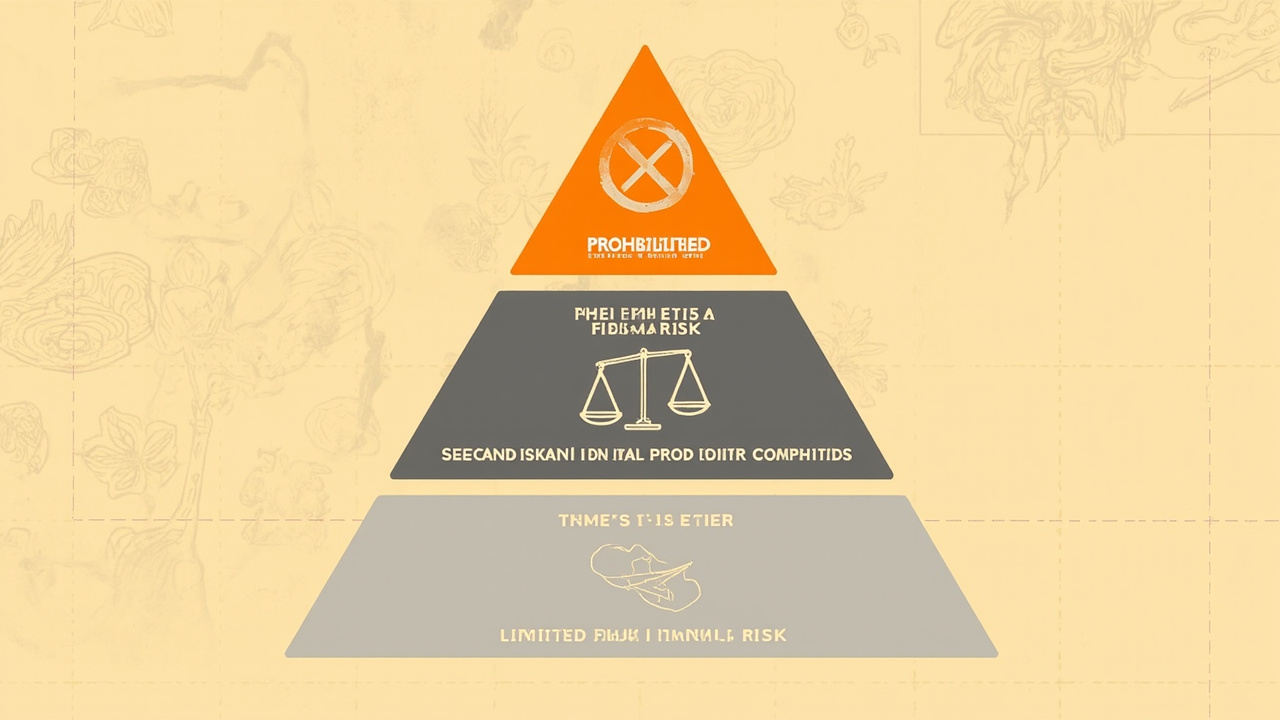
The Act sorts AI systems into four tiers. The tier determines what obligations apply.
1. Unacceptable risk (prohibited)
These systems are banned from being placed on the EU market. The prohibitions became enforceable on February 2, 2025 — six months earlier than the main applicability date. The list:
- Subliminal manipulation techniques that distort behavior and cause significant harm
- Exploitation of vulnerabilities due to age, disability, or social/economic situation
- Social scoring by public authorities (with narrow exceptions)
- Real-time remote biometric identification in publicly accessible spaces for law enforcement (with narrow exceptions)
- Predictive policing based solely on profiling
- Untargeted scraping of facial images to build recognition databases
- Inferring emotions in workplaces and educational institutions (with medical/safety exceptions)
- Biometric categorization that infers sensitive attributes (race, political opinion, trade union membership, religious beliefs, sex life, sexual orientation)
The list is specific. If your system does any of these things, it’s prohibited. There’s no compliance path — the system can’t be deployed.
2. High risk (regulated)
The long list. High-risk AI systems are those used in:
- Critical infrastructure (water, gas, electricity, traffic management)
- Education and vocational training (admissions, assessment, proctoring)
- Employment (recruitment, promotion, task allocation, termination, monitoring)
- Essential services (credit scoring, insurance pricing, emergency dispatch)
- Law enforcement (risk assessment, lie detection, evidence reliability)
- Migration and border control
- Administration of justice and democratic processes
- Biometric identification (non-real-time, with caveats)
- Safety components in products covered by EU product safety legislation (toys, medical devices, vehicles, machinery)
For these systems, the obligations include conformity assessment, risk management throughout the lifecycle, training/validation/testing data governance, technical documentation, record-keeping, transparency to users, human oversight, accuracy/robustness/cybersecurity levels, and post-market monitoring.
This is where the engineering work lands. A “high-risk” AI system needs a documented data lineage, a tested bias profile, ongoing monitoring infrastructure, and a clear human-in-the-loop architecture.
3. Limited risk (transparency obligations)
These systems can be deployed but must meet transparency rules:
- Chatbots and conversational AI: users must know they’re talking to an AI
- Generative AI: outputs must be marked as artificially generated
- Emotion recognition systems: users must be informed
- Biometric categorization: users must be informed
- Deepfake generation: users must be informed
The obligations here are lighter than high-risk — primarily disclosure and user awareness. If your product is a chatbot or generates synthetic media, you need disclosure UX, but you don’t need a full conformity assessment.
4. Minimal risk (no obligations)
Everything else. Spam filters, video game NPCs, AI-powered spreadsheets, recommendation systems outside the high-risk domains, search engines. The Act explicitly says these systems are not subject to additional obligations beyond existing law.
Most AI products land here. If you’re building a developer tool, a productivity app, a content recommendation system, or a non-decision-making assistant, the Act doesn’t add obligations on top of what GDPR and existing product law already require.
What the GPAI provisions actually require
Articles 50–55, enforceable from August 2, 2025, are the obligations for general-purpose AI model providers. If your model has “significant generality” — meaning it can perform a wide range of distinct tasks — the obligations may apply to you.
The technical requirements:
- Training data summary: a sufficiently detailed summary of the training data, including data sources, data types, data volume, and curation methodology. The Commission published draft guidelines on this in July 2025.
- Copyright compliance: a policy demonstrating compliance with EU copyright law, including the text-and-data-mining opt-out under Article 4(3) of the Copyright Directive. This is the part where “we trained on the open internet” stops being a sufficient answer.
- Technical documentation: model architecture, training process, evaluation results. The “model card” concept formalized into law.
- Downstream provider information: documentation for downstream providers who will integrate the model, including capabilities, limitations, and intended purposes.
- Cooperation with authorities: information requests, incident reporting, access to model artifacts for regulatory inspection.
If your model is classified as a “GPAI model with systemic risk” — generally meaning the model has training compute above 10^25 FLOPs — additional obligations apply: model evaluation and adversarial testing, systemic risk assessment, serious incident reporting, cybersecurity protection.
What this looks like in a working codebase
If you’re building an AI product in 2026, the AI Act’s impact depends on which risk tier you’re in. For most developer-tool and productivity products (minimal risk), the Act is essentially a non-event beyond GDPR. For products that touch hiring, education, credit, law enforcement, healthcare, or biometric identification (high risk), the engineering work is substantial.
The concrete obligations for a high-risk system:
- Data lineage documentation: every training and inference data source documented with provenance, consent status, and bias assessment. This needs to be a live system, not a one-time artifact.
- Bias testing infrastructure: a tested, repeatable bias evaluation suite that runs against the model before each deployment. The Act doesn’t specify metrics, but the standard practice is accuracy disparity across protected classes, with documented acceptance thresholds.
- Human oversight mechanism: the system architecture must allow a human to override, reverse, or substantially modify the AI’s output. For consequential decisions (hiring, credit, sentencing), the human must be a meaningful check, not a rubber stamp.
- Logging and traceability: the system must log inputs, outputs, model versions, and human interventions in a way that allows post-hoc reconstruction of any decision.
- Transparency to users: affected individuals must receive meaningful information about how the AI decision was made. For credit decisions, this means specific reason codes; for hiring, this means feedback on the assessment factors.
- Post-market monitoring: a deployed high-risk system must have an ongoing monitoring plan that detects drift, emergent bias, and unexpected behavior. The Act expects this to be infrastructure, not a one-time audit.
For a GPAI model provider:
- Training data summary template: the Commission’s draft guidelines from July 2025 set out the expected format. If you’re shipping a foundation model, this needs to exist as a public artifact.
- Copyright compliance policy: a published document explaining how you handle the TDM opt-out, what data you use, and what rights holders can do if they want their content excluded.
- Model card: the standard model card format aligns well with Act requirements. If you’re already writing model cards for Hugging Face or internal documentation, you’re most of the way there.
- Downstream documentation: a public artifact explaining intended uses, known limitations, and evaluation results. This is the “responsible AI” page most serious labs already publish.
- Incident reporting pipeline: a route for downstream providers and authorities to report serious incidents. This is a process and a contact, not a technical artifact.
The Act’s GPAI obligations are not a heavy lift for a lab that already takes responsible-AI seriously. They are a heavy lift for an open-weights hobbyist release. That’s intentional.
Why the regulation looks the way it does
Three structural choices in the AI Act reflect the EU’s theory of regulation:
Risk-tiered rather than one-size-fits-all. The Act treats a spam filter and a hiring-decision model as fundamentally different regulatory objects. This is consistent with EU product-safety law (CE marking, low-voltage directive, etc.) — the regulation scales with the risk profile, not the technology category.
Process obligations over prescriptive technical standards. The Act says “you must have a risk management process,” not “your model must have accuracy above X percent on benchmark Y.” This gives the regulation longevity as the technology changes — the obligations are about what you do, not what numbers you hit.
Ex-ante conformity assessment plus post-market monitoring. High-risk systems need a conformity assessment before being placed on the market (CE marking style), and ongoing monitoring after deployment. This is a familiar regulatory pattern for product safety and medical devices; extending it to AI is the EU’s natural move.
The Act is not designed to make AI development impossible in Europe. It’s designed to make the deployment of high-risk AI in consequential domains as rigorous as the deployment of medical devices or industrial machinery. For most AI products — the ones that fall into minimal or limited risk — the regulatory load is light.
What it doesn’t do
Three things the AI Act doesn’t address, despite frequent misperception:
It doesn’t require disclosure of model weights. The Act applies to AI systems and GPAI models as deployed, not to research artifacts. If you’re publishing open weights for academic purposes, you’re not deploying a regulated product.
It doesn’t ban open-source AI. The Act has explicit carve-outs for certain open-source AI components, though the precise scope has been contested in the implementation. As of August 2026, the carve-outs are narrower than the open-source community initially hoped, but the Act is not a ban on open-weights releases.
It doesn’t apply outside the EU. The Act’s territorial scope is the EU market — placing AI systems on the EU market or putting them into service in the EU. If your product is available globally but you don’t actively market to EU users, the analysis is more nuanced. The Commission’s guidance on extraterritorial scope is still developing.
The state of play in August 2026
The Act became fully applicable on August 2, 2026. What’s happening now:
- The AI Office (within the European Commission) is operational and coordinating enforcement across member states
- National competent authorities in each member state are designated and beginning enforcement actions
- The Code of Practice for GPAI models was published in July 2025 and provides a compliance pathway for foundation model providers
- Sandbox programs for high-risk AI development are running in multiple member states, allowing controlled testing under regulator supervision
- Standardization bodies (CEN-CENELEC JTC 21) are working on harmonized standards for the high-risk obligations
The first enforcement actions and penalties are expected in late 2026 and 2027. The Commission has signaled it will prioritize systemic-risk GPAI providers and high-risk deployments in hiring and education for early enforcement.
Where to dig further
- EU Commission: AI Act page — primary regulatory source, timeline of applicability dates
- artificialintelligenceact.eu — maintained by the Future of Life Institute; consolidated high-level summary and Code of Practice documentation
- EUR-Lex Regulation (EU) 2024/1689 — the actual regulation text. It’s readable, with definitions and risk classifications in the annexes
- Code of Practice for GPAI — the compliance pathway for foundation model providers
- Orrick AI Law Center guide — practitioner-focused summary with specific obligations for providers, importers, distributors, deployers
- Dentons: September 2025 implementation update — current state of national implementation across member states
If you’re building AI products, the AI Act is now part of the design conversation. For most products, the regulatory load is light and overlaps with existing GDPR work. For products in the high-risk tier, the engineering investment in data lineage, bias testing, human oversight, and post-market monitoring is substantial — and it’s the kind of investment that pays back in product quality even if the regulation didn’t exist.
The reason the regulation is the shape it is: the EU is treating AI systems with the same regulatory logic it applies to medical devices, product safety, and critical infrastructure. That logic assumes that consequential systems need process discipline, not just capability. If you build consequential AI systems, the discipline is coming whether or not you read this post.
Comments
Powered by GitHub Discussions via Giscus. Sign in with GitHub to leave a comment.