Two weeks ago, a developer named RyanCodrai published a repo called turbovec. The pitch: a vector index built on Google Research’s TurboQuant algorithm, written in Rust, with Python bindings. Today it has 11,400 stars on GitHub, trending, integrations with LangChain and Agno, and a YouTube walkthrough titled “Run Google’s AI RAG on 4 GB RAM.”
That last part is the headline that matters.
What TurboQuant Actually Does (and Why Papers Don’t Show the Code)
Google Research published TurboQuant at ICLR 2026. The paper’s core claim: you can compress LLM KV caches to 3 bits per value — roughly 6× memory reduction — with essentially zero accuracy loss. On the LongBench benchmark with Llama-3.1-8B, a 3.5-bit TurboQuant cache matched a full-precision cache. Even at 2.5 bits, degradation was marginal.
The mechanism is data-oblivious vector quantization — unlike standard PQ or SQ approaches, TurboQuant constructs codebooks that are independent of the data distribution. That independence is what makes it robust: it doesn’t need to see your specific embedding vectors to compress them well.
The problem? The paper demonstrated this on KV cache compression — optimizing attention computation inside the model. It did not ship a vector index you could use today.
That’s the gap turbovec fills.
Turbovec: The Application Layer on Top of the Algorithm
RyanCodrai took TurboQuant’s core insight — data-oblivious quantization with near-optimal distortion — and built a vector index around it. The result is a Rust library (turbovec-core) with Python bindings via PyO3. You install it with:
pip install turbovec
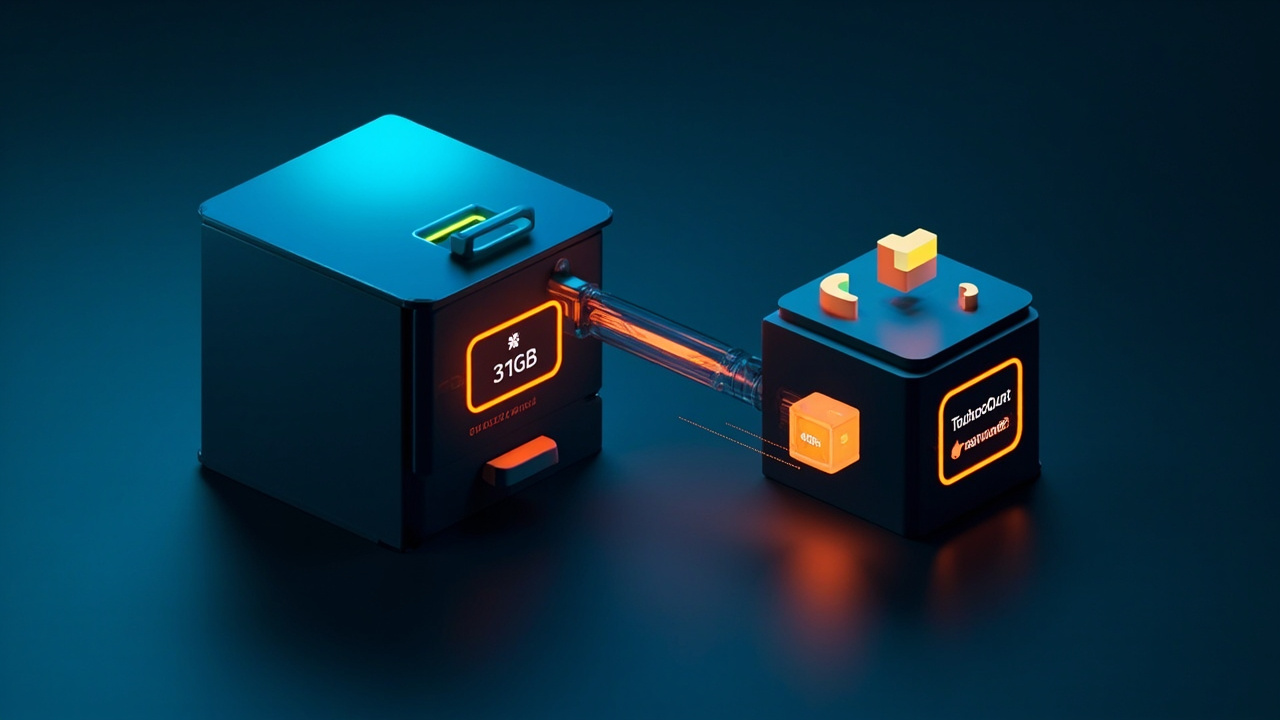
The architecture: embeddings go in, get quantized using the TurboQuant scheme, get stored in an on-disk index, and queries retrieve compressed vectors with minimal accuracy loss. The 16× compression ratio reported in benchmarks means a 31 GB corpus becomes 4 GB on disk.
For context: that 31 GB corpus represents roughly 10 million documents at typical embedding sizes. Four gigabytes fits on a budget NVMe drive, or in RAM on a machine that couldn’t hold the original.
The Numbers Worth Knowing
From published benchmarks (MarkTechPost, Medium coverage from May 2026):
- Compression: 10M docs: 31 GB → 4 GB (16×)
- Speed vs FAISS: 12–20% faster on ARM processors
- Accuracy: Near-lossless at 3.5 bits per channel (matches full precision on LongBench)
- Language: Rust core, Python bindings, also a llamacpp-compatible variant
The ARM benchmark matters more than it might seem. Most local RAG comparisons focus on x86 desktop chips. But a meaningful slice of “local RAG” is now happening on ARM machines — MacBooks, developer Chromebooks, even single-board computers running local models. Turbovec was apparently designed with that in mind.
Five Use Cases That Just Became Realistic
1. RAG on a MacBook Air
A 16 GB MacBook Air cannot hold a 31 GB vector corpus in RAM. It also shouldn’t need to. With turbovec, the same corpus fits in ~4 GB, which means you can run a full local RAG pipeline — Ollama for inference, turbovec for the vector index — without touching the network. No API calls, no data leaving the machine. The privacy implications for anyone working with sensitive codebases or internal documents are straightforward.
2. Air-Gapped Enterprise RAG
If you’ve tried to build a RAG system inside a hospital, law firm, or government contractor, you know the constraint: no external API calls. Your embedding provider probably requires one. Turbovec pairs with any open-source embedding model — text-embedding-3-small is off the table, but mxbai-embed-large or nomic-embed-text are not. You can now ship a fully air-gapped RAG stack: open embedding model, turbovec index, local LLM inference via Ollama or llama.cpp.
3. Long-Running Research assistant
Research RAG workloads are different from chatbot RAG. You’re often running 50–200 document retrieval sessions per day, across a corpus you’ve built up over months or years. The KV cache pressure on the inference side is constant, and the vector index size grows with the corpus. Turbovec’s compression means your index stays manageable as the corpus grows — you’re not re-architecting every six months because the vector store crossed another RAM boundary.
4. Multi-Model Comparison Pipelines
If you run evals across multiple embedding models (testing bge-base vs nomic vs e5-mistral on your specific corpus), you’re usually maintaining separate indexes for each. With 16× compression, you can afford to keep multiple indexes at once without the storage math becoming embarrassing. This is a workflow improvement more than a headline feature, but for people building eval infrastructure, it changes the calculus on what “too expensive to test” means.
5. Embedded / Edge Deployment
The combination of Rust’s zero-cost abstractions, ARM-optimized performance, and compressed storage opens a path to running RAG on edge hardware that was previously impractical. A Raspberry Pi 5 with 8 GB RAM and a 256 GB SSD can now hold a compressed index that would have required 50+ GB unmapped. You’re not running GPT-4 class inference there — but you can absolutely run a quantized Mistral or Phi-3 with a local vector index answering questions against a documentation corpus.
The Integration Story
The repo ships with first-class integrations for LangChain and Agno (theagno.com framework). There’s also a llamacpp variant and an Ollama-compatible mode. If you’re already using LangChain’s vector store abstractions, swapping in turbovec is a five-line change to the from_documents call.
This is the unsexy part that matters for adoption. A fast algorithm that requires rewriting your retrieval pipeline is a research contribution. A fast algorithm that drops into LangChain’s existing abstraction — that’s a product.
What TurboQuant’s Authors Got Right
The paper’s core insight — data-oblivious quantization — was genuinely novel when published. Most vector quantization schemes (PQ, OPQ, ISQ) are data-dependent: they need to see the actual vectors to build good codebooks. TurboQuant’s independence from the data distribution means it works on arbitrary vectors without a training step, without per-corpus calibration, and without accuracy degradation when the data distribution shifts.
RyanCodrai correctly identified that this property makes it ideal for a vector index: you don’t retrain your compression scheme every time you add documents. The codebook is universal.
The Caveats Worth Naming
No post about a trending repo should skip caveats.
First, TurboQuant on KV cache and TurboQuant on vector indexes are different use cases. The paper’s benchmarks are for attention KV caches — the compression behavior on semantic embedding vectors (which have different statistical properties) hasn’t been independently replicated at scale. The 16× compression figure comes from turbovec’s own benchmarks; Google Research hasn’t published specifically on embedding vector quantization.
Second, the controversy. Shortly after the ICLR paper was published, a researcher (Cheng Long, LinkedIn, March 2026) published a detailed rebuttal claiming the paper misrepresented an earlier algorithm called RaBitQ in its related work section. The TurboQuant authors responded on OpenReview. This is a technical dispute I’m not positioned to adjudicate — but for a blog post about a repo built on TurboQuant, it’s worth knowing the paper has critics.
Third, this is early-stage software. Two weeks of GitHub history means the API surface is likely to change, documentation is sparse, and the LangChain integration is probably the path of least resistance rather than the path of least surprise.
The Practical Bottom Line
If you’re running local RAG today and fighting with index size, model VRAM, or corpus management — turbovec is worth a weekend afternoon to evaluate. The compression numbers are real, the Rust implementation is credible, and the Python bindings lower the bar to entry significantly.
If you’re on an M-series Mac and running Ollama, the setup is roughly: install turbovec, point it at your corpus, swap your LangChain vector store. The YouTube walkthrough from roughly a week ago (“TurboVec: Run Google’s AI RAG on 4 GB RAM”) walks through the full pipeline end-to-end.
The 11k stars aren’t accidental. TurboQuant solved the compression problem. Turbovec solved the “now what do I do with it” problem. That’s a useful combination.
Comments
Powered by GitHub Discussions via Giscus. Sign in with GitHub to leave a comment.