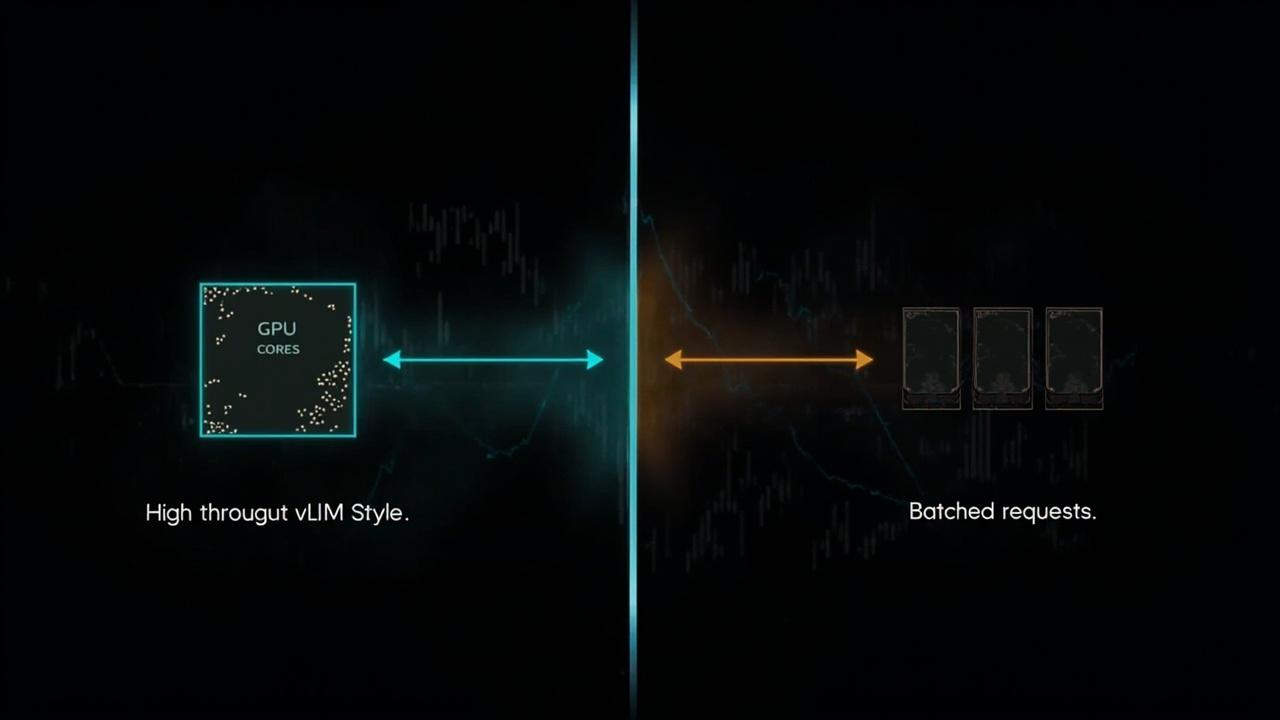
A benchmark result from Tech Insider circulated in local AI communities last month: vLLM v0.19.0 (April 3, 2026) delivered 9x throughput over Ollama v0.6.8 (May 3, 2026) on the same hardware. The comments section predictably exploded into one-upmanship. But the real story is quieter and more useful than the benchmark war: these two engines have stopped competing and started serving fundamentally different operational needs.
What the Benchmark Actually Shows
The 9x figure comes from continuous batching — vLLM’s ability to dynamically multiplex incoming requests through the GPU rather than processing them serially. Ollama’s architecture doesn’t do this; it’s optimized for single-user, low-latency generation. At batch size 1, the gap largely disappears because both engines saturate the same GPU tensor cores.
The comparison only makes sense if you’re running a production inference server handling concurrent requests. For a developer iterating locally on prompts, or an agent that makes one request at a time and waits for the result, Ollama is often the better choice precisely because it has less overhead and starts faster.
This is what orthogonal tradeoffs look like in practice: not a linear “better/worse” scale, but a two-dimensional space where the axes are “throughput” and “latency at low concurrency.”
The AMD ROCm Dimension
The picture gets more interesting when you add AMD to the matrix. ROCm 7.2.3 shipped in May 2026 with improved profiling stability for vLLM workloads. More significantly, the lemonade-sdk/vllm-rocm project started releasing portable builds for gfx120X (RDNA 3-era Radeon hardware) on May 10, 2026 — self-contained archives bundling Python, PyTorch ROCm, and the runtime with no separate installation steps.
On the consumer side, an RX 7900 XTX running vLLM with GGUF support pushes around 62 tokens/second at batch size 1 versus 58 from Ollama on the same card. The gap is small at single-user load, which is exactly what you’d expect. The differentiation shows up in multi-user scenarios where vLLM’s paged attention manages the KV cache more efficiently.
AMD’s ROCm becoming a first-class platform in vLLM (officially announced January 21, 2026) means local AI practitioners have a credible alternative to NVIDIA for self-hosted inference. This matters for cost-sensitive deployments and for teams building agent systems that need to run entirely on-premises.
Where the Orchestration Layer Fits
Here’s the part the benchmarks don’t capture: even if you pick the “right” inference engine, you’ve only solved part of the problem. A multi-agent system that spawns three sub-agents — each potentially connecting to different models on different inference engines — needs coordination that sits above the inference layer entirely.
ACO System, for instance, runs a pipeline where a Planner agent outputs execution-ready task specifications, a Developer agent handles implementation, and a QA agent validates the output. Each stage can invoke different models with different inference backends. The throughput advantage of vLLM doesn’t help if your orchestration layer can’t efficiently distribute work across those backends.
This is the “orchestration layer” problem that the r/LocalLLaMA community flagged as the underappreciated constraint of 2026: the biggest bottleneck isn’t model quality or raw inference speed. It’s the system that decides which model handles which task, how results flow between stages, and how the whole pipeline recovers when a step fails.
Practical Implications for Agent Builders
If you’re building agent systems today, the inference engine decision should follow from your operational context:
-
High-concurrency production部署: vLLM with continuous batching. The throughput gains are real and compound with user load. AMD ROCm support means you can run this on consumer hardware without being locked to NVIDIA.
-
Single-user local development: Ollama. The friction to get a model running is lower, startup time is faster, and the CLI/API surface is simpler. For iterating on prompts or debugging agent behavior, this is the right tool.
-
Heterogeneous multi-agent pipelines: The engine choice matters less than the coordination layer. ACO System’s approach of defining task specs that flow between specialized agents is more impactful than which inference engine each agent uses.
The 9x benchmark number is real. But it’s a tool selection criterion, not a verdict on which engine “wins.” The practitioners who are actually shipping agent systems in production have already figured this out — they’re running vLLM for their API-facing inference servers and Ollama for their local development loops, sometimes on the same project.
The inference engine market in 2026 has matured past the point where one engine dominates across all use cases. That’s a sign of a healthy ecosystem, not confusion. The interesting problems — and the interesting writing — now lives one layer up.
Comments
Powered by GitHub Discussions via Giscus. Sign in with GitHub to leave a comment.