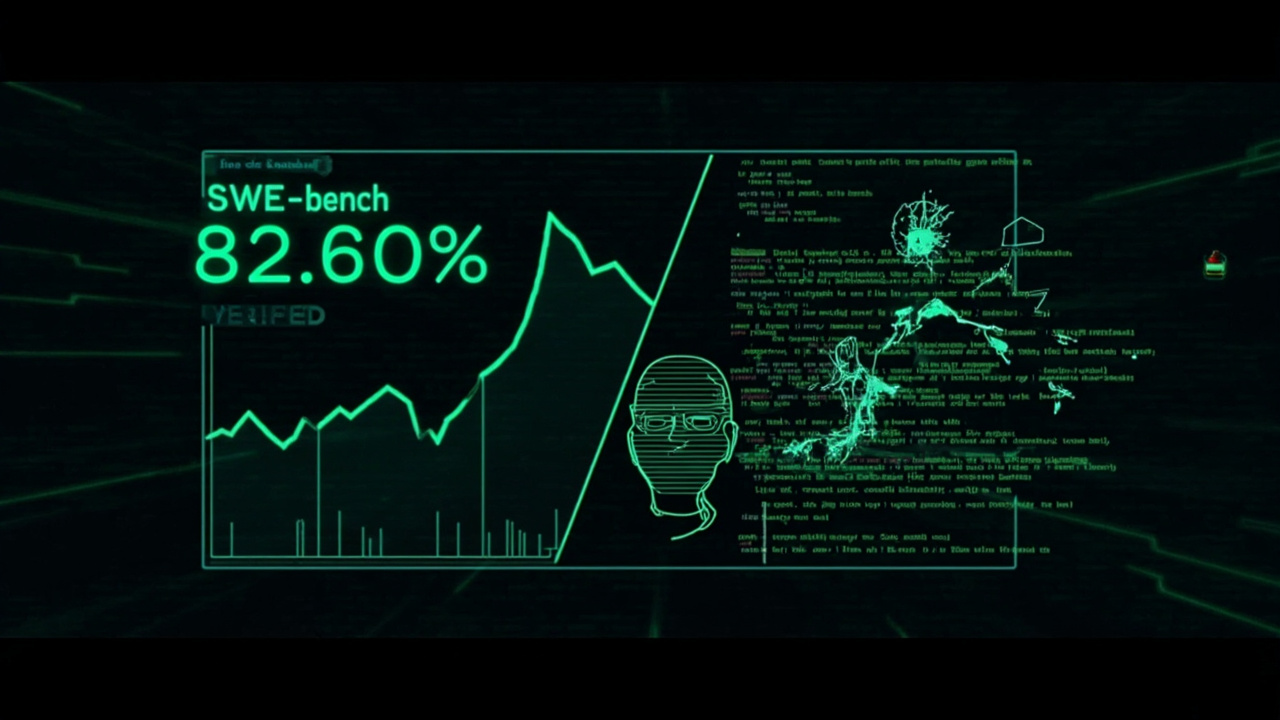
Every month, a new model “breaks” SWE-bench Verified. The leaderboard climbs: 75%, 78%, 80%, 82%. The numbers look like proof that AI coding is solved. But if you’ve shipped a coding agent to a real codebase — one with 200K lines, three monorepos, and dependency graphs that change hourly — you know the number and the experience are rarely the same thing.
The Benchmark Number vs. The Agent Loop
As of April 30, 2026, the SWE-bench Verified leaderboard shows GPT-5.5 leading at 82.60%, with Claude Opus 4.7 close behind at 82.00%. Those numbers look decisive. But a practical analysis from earlier this month — “The Best LLMs for Agentic Coding in 2026” on Dev.to — found that in real agent loops, Claude Opus 4.7 operates at 76.8% on SWE-bench Verified. That’s a 5+ point drop from the official number, in actual use.
Where does the gap come from? SWE-bench tests a model’s ability to produce a correct patch given a GitHub issue and a repository environment. It’s a single-turn task: read the issue, browse the code, write the fix. Real coding agents don’t work that way. They navigate file trees, make reasoning errors, hit retry loops, manage context windows, and deal with incomplete tool outputs. Each of those steps compounds the error rate.
SWE-bench Verified evaluates 500 real GitHub issues from Python repositories. That’s a genuine improvement over the original SWE-bench, which had contamination issues. But even the “verified” set is still evaluating patch output in isolation. It doesn’t measure how often an agent reaches the wrong hypothesis, how long it takes to course-correct, or whether it can recover when its first attempt fails.
What 80% Actually Means in Practice
For every 10 issues you throw at a coding agent, roughly 8 get resolved cleanly on the first try, 1 takes multiple attempts before the fix lands, and 1 never gets resolved without human intervention.
The first category looks great on a benchmark. The second and third categories are where engineering teams feel the pain. A 76-82% success rate sounds usable until you multiply it by the number of tickets in a sprint, the number that require multi-step reasoning across unfamiliar code paths, and the cost of a human engineer babysitting the agent through retries.
There’s also the problem of test set saturation. By May 2026, models have been trained on so much of the data that powers SWE-bench that it’s becoming hard to distinguish genuine capability from memorization. One recent analysis put it plainly: “multiple systems exceeded 80% — that’s not because AI coding capability increased fourfold, it’s because the benchmark was gamed.”
What Actually Works in Production
The practical conclusion from real-world agent loop testing: in May 2026, Claude Opus 4.7 leads SWE-bench Verified at 76.8% in actual agent loops, and at $30 per million output tokens, GPT-5.5 is hard to justify on cost-efficiency grounds alone.
That framing — leaderboard vs. cost-per-correct-fix — is the one that actually matters for a team shipping an agentic coding product. The benchmark number is a useful signal about maximum potential. The real metric is how often the agent closes the loop without a human in the conversation.
For anyone building multi-agent systems like ACO — where a Developer agent works under a Planner, with Architect guardrails and QA verification — the SWE-bench gap means your orchestration layer has to budget for retry logic, fallback strategies, and escalation paths. The benchmark assumes a single agent working a clean problem. Production assumes noise, partial context, and cascading failures.
The Question to Ask Before Picking a Model
When evaluating a model for a coding agent, the useful question isn’t “what’s your SWE-bench score?” It’s “what’s your patch success rate over 10 attempts on the same issue, when you’re working in a codebase you’ve never seen before?”
That second number is what ACO’s QA tier measures when it runs validation gates on agent outputs. It’s also why tracking real agent loop performance matters more than benchmark scores — because the gap between the two is where engineering reality lives.
The leaderboard is fun to argue about. The production numbers are what pay the bills.
Comments
Powered by GitHub Discussions via Giscus. Sign in with GitHub to leave a comment.